Questionnaire Surveys
140 likes | 256 Vues
Questionnaires are effective tools for gathering data by asking respondents standardized questions, allowing for rapid collection of information on people's views, opinions, and attitudes. They can feature open-ended questions for qualitative data or closed questions for quantitative insights. Key types of closed questions include straightforward responses, checklists, and ranking scales. While questionnaires are cost-effective and minimize investigator bias, they can suffer from issues like social desirability bias and low response rates. Designing effective questionnaires is crucial for obtaining accurate and meaningful data.


Questionnaire Surveys
E N D
Presentation Transcript
Questionnaire Surveys • Obtaining data by asking people questions and recording their answers • A standardised set of question is given to each respondent; they give their answers in writing • Gets you lots of data quickly and gives you an insight into people’s views, opinions and attitudes • But only if they answer accurately
Types of Question • Open questions • Allow respondents to answer however they want • Generate qualitative data • Closed questions • Restrict respondent to a predetermined set of responses • Generate quantitative data
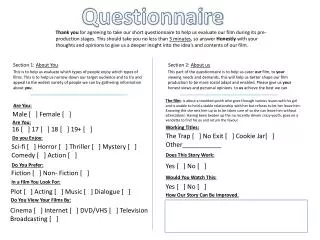
Types of Closed Question • Straightforward response • Are you female or male? M F • What is your age in years? ____ years • Do you smoke? Yes No
Types of Closed Question • Checklist • What is the highest academic qualification you hold? • GCSEs • A – Levels • Undergraduate degree • Post-graduate degree
Types of Closed Question • Adjectival/adverbial response • Does your anxiety affect your ability to do the following things?
Types of Closed Question • Numerical (Likert) response scale • Psychology is the most interesting A-Level subject
Types of Closed Question • Ranking scale • Rank the following activities according to how much time you spend on them each day (1 = most time, 4 = least time) • Talking face to face • Talking on the telephone • Text messaging • Other (e.g. MSN, IRC chat)
Advantages of questionnaires • Can collect a lot of data about attitudes and what people think rather than just what they do • Cheap and efficient – researcher doesn’t need to be present while Ps completes questionnaire • Fewer investigator effects (because fewer interpersonal factors influence Ps)
Disadvantages of questionnaires • Social desirability bias – presenting yourself in a favourable light • People may give untruthful answers (especially for sensitive topics) • Low response rates (only most motivated Ps reply) • Difficult to phrase Qs clearly – Ps may interpret Qs in different ways
Factors in questionnaire design • Match the factor to the appropriate description on the next page. • N.B. They are not in the correct order!
Design your own questionnaire • Choose one topic • Follow the instructions • Hand in one side of A4 summary on the bullet points next lesson.
Interviews • Download the document title ‘Interviews in psychological research’ from the website and complete the mind map in your booklet.
Homework • Answer the true/false questions about interviews in your booklets • If the statement is false, correct it and if it is true, elaborate on the point to explain it. • All work MUST be completed for next week’s lesson: come and see me or email if you have any questions.