Download
1 / 2
20 likes | 133 Vues
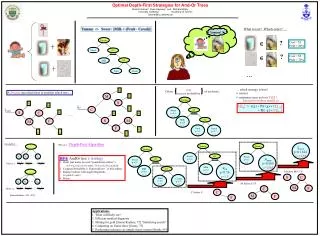
This study explores the optimal testing strategies for determining the best combination of milk, fruit, and cereal based on cost and success probabilities. The analysis employs Depth-First Algorithms (DFA) to derive strategies for And-Or trees, determining the best order for tests to minimize expected costs. With applications ranging from medical diagnoses to expert systems, the research reveals the efficiency of linear strategies while addressing the potential suboptimal nature of DFA in certain tree structures. Published by Russell Greiner, Ryan Hayward, and Michael Molloy.

E N D
Yummy i#1 Sweet i#2 Milk Fruit Cereal + M + Yummy S + + nl - C smcf i#1 Sweet p=0.3c=1 S C + + + S M i#2 F Milk p=0.8c=1 M cost success probability F - Fruit p=0.2c=1 Cereal p=0.7c=1 - - - Optimal Depth-First Strategies for And-Or Trees Russell Greiner*, Ryan Hayward and Michael Molloy University of Alberta University of Toronto *greiner@cs.ualberta.ca Yummy Sweet v[Milk & (Fruit vCereal)] What to test? Which order? … Yummy! ? ? Cost = $1 Prob = 80% ? Cost = $3 Prob = 70% … • … which strategy is best? • correct • minimize expected costC[]! • Expected Cost of subtree rooted in is … Given of each test, A Strategyspecified when to perform which tests… C[] = c() + Pr(+) C[+] + Pr( -) C[-] … Why not… Depth-First Algorithm For depth 1… Yummy Yummy smcf p=0.1824c=2.428 Yummy … X1 X2 Xm i#1 Sweet p=0.3c=1 Sweet p=0.3c=1 • DFA( AndOr tree ): strategy • Order leaf nodes (in each “penultimate subtree”) • by P(+Xi)/c(Xi) for Or-nodes; P(-Xi)/c(Xi) for And-node • Compute Probability P, ExpectedCost C of this subtree • Replace subtree with single MegaNode, • w/ prob P, cost C • Recur… i#1 NMCF p=0.608c=2.04 Sweet p=0.3c=1 Order s.t. Milk p=0.8c=1 NCF p=0.76c=1.3 i#2 Milk p=0.8c=1 S before M+C+F S C Fruit p=0.2c=1 … Cereal p=0.7c=1 X1 X2 Xm M before C+F M F C Order s.t. C C before F M F [Simon/Kadane, AIJ, 1975] F • Applications: • What will Baby eat? • Efficient medical diagnosis • Mining for gold [Simon/Kadane, 75] “Satisficing search” • Competing on Game show [Garey, 73] • Performing inference in simple expert system [Smith, 89]
Yummy + + i#1 S C Sweet + F M i#2 - - Cereal Milk Fruit Lab p=0.95c=5.1 Milk p=0.8c=1 AndOr trees read-k formulae optimal near-optimal linear -- • Theorem: • DFA is optimal for • depth-1 trees • depth-2 trees (-DNF, - CNF). Theorem: DFA is SUBoptimal for depth-3 trees. Theorem: >0, DFA on unit-cost tests can be n1- worse than optimal!! Results Tree (not DAG) Independent tests Arbitrary costs + But , non-DFA … smcf M + DFA returns: nl • Note for unit-cost tests: • Max possible expected cost is n. • Max possible expected cost is 1. • So n times worse is worst possible!! • Why? • DFA forces siblings to be considered together, • so bad (low p/c) nodes can hamper good (high p/c) siblings. S - C … + + S M F - C[ smcf ] = 2.428 > 2.392 = C[nl ] !! … A1 Am … … - B1 Bm Z1 Zm Results, wrt Preconditions… • Precondition Model: • Each intermediate node is a probabilistic test --- with • its success probability and cost.. • Linear Strategy: • A strategy is linearif it performs the tests in fixed linear order, • skipping any test that will not help answer the question, given known info. Theorem: DFA produces a LINEAR strategy.. • DFA DFA but … • uses [Smith’89] for each “leaf subtree Note: • if internal tests have cost=0 and probability=1 • then DFA= DFA Yummy smcf • Laboratory test for Fruit, Cereal • Cost to SEND TO LAB is 5.1 • Only 95% chance mail will succeed + + Linear! S C + i#1 • Theorem • DFA is optimal for • 0-alternation trees • 1-alternation trees F Sweet p=0.3c=1 M • Theorem: • >0, and-or tree whose optimal linear strategy costs n1/3- worse than optimal!! - - + M nl • Corollary: • DFA is SUBoptimal for depth-3 trees. • >0, DFA on unit-cost tests can be n1- worse than optimal!! + S - C Non-Linear: Sometimes sometimes + + M before S Fruit p=0.2c=1 Cereal p=0.7c=1 S M S before M F - - • Future work: • Complexity of computing strategy for ? • poly time algorithm? • Empirical studies, on real-world tasks This work was partially funded by various grants from NSERC