Download
1 / 15
150 likes | 268 Vues
Scientists are everyday individuals who share many of the same interests and activities as the rest of us. Beyond their lab work, they engage in outdoor adventures, reading, and various hobbies. The perception that scientists are isolated from society is misleading; they are part of a vibrant community with lives and passions outside their professions. This piece explores the normalcy of scientists, their fascinating work in fields like sonochemistry, and highlights applications like medical ultrasound and chemical enhancements.

E N D
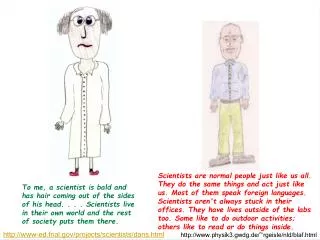
Scientists are normal people just like us all. They do the same things and act just like us. Most of them speak foreign languages. Scientists aren't always stuck in their offices. They have lives outside of the labs too. Some like to do outdoor activities; others like to read or do things inside. To me, a scientist is bald and has hair coming out of the sides of his head. . . . Scientists live in their own world and the rest of society puts them there. http://www-ed.fnal.gov/projects/scientists/dans.html http://www.physik3.gwdg.de/~rgeisle/nld/blaf.html
Sonoluminescence Sound into Light
Applications of Ultrasound • Enhancement of chemical reactions (sonocatalysis and sonochemistry) • Cleaning • Medical procedures • Treatment of industrial liquid waste • Possible nuclear aspects?
Heterogeneous Sonochemistry Particle size reduction Titanium foil after sonication (true color) http://www.aeat.co.uk/sono/ http://rsrch.com/saturna/sonofusion.html
System of many bubbles Light emission correlates to bubble collapse Multibubble systems drive heterogeneous sonochemistry System of one bubble driven by a resonant frequency Light emission correlates to minimum resonant bubble size More difficult to obtain MBSL versus SBSL
Light emission of MB and SB systems is different MBSL SBSL http://www.scs.uiuc.edu/suslick/images/sonolum.luminol.horn.jpg http://mmae.iit.edu/communications/vectors/apr97/bubble.gif
The SL emission intensity is directly proportional to the atomic number of the noble gas saturated in the solution.
Other factors affect SL intensity • pH of solutions doped with alkyl acids or akylamines • Temperature of solutions (20-25° C most research data) • Vapor pressure (SL intensity α 1/vapor pressure)
Model of bond cleavage/temperature due to cavitational “hot-Spot” Energy release during cavitational collapse causes the chemical bonds to dissociate. Triply-bonded molecules such as N2 require higher temperatures for bond cleavage.
Frequencies of about 20-40kHz Horn external to bath Not sealed Large container Frequencies of up to 1MHz Horn Immersed in bath Sealed Small container TESCSonicators Sonochemistry Equipment
Sonochemistry Equipment http://www.scs.uiuc.edu/suslick/britannica.html