Finite State Machines
This resource provides a comprehensive overview of Finite State Machines (FSMs), covering their essential components, types (Mealy and Moore), and practical applications in designing logic circuits with state. The document walks through the theoretical foundations of FSMs, including the state transition function and how outputs depend on both current states and inputs. Additionally, it presents examples, such as a serial adder and digital door lock, along with strategies for building FSMs through state diagrams and logic equations. Ideal for computer science students and enthusiasts.


Finite State Machines
E N D
Presentation Transcript
Finite State Machines Hakim Weatherspoon CS 3410 Computer Science Cornell University [Weatherspoon, Bala, Bracy, McKee, and Sirer]
StatefulComponents Combinationial logic • Output computed directly from inputs • System has no internal state • Nothing depends on the past! Need: • To record data • To build stateful circuits • A state-holding device Sequential Logic & Finite State Machines Combinationalcircuit Inputs Outputs N M
Goals for Today • Finite State Machines (FSM) • How do we design logic circuits with state? • Types of FSMs: Mealy and Moore Machines • Examples: Serial Adder and a Digital Door Lock
Next Goal • How do we design logic circuits with state?
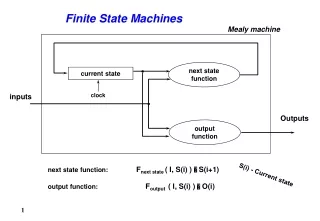
Finite State Machines An electronic machine which has • external inputs • externally visible outputs • internal state Output and next state depend on • inputs • current state
Abstract Model of FSM Machine is M = (S, I, O, ) S: Finite set of states I: Finite set of inputs O: Finite set of outputs : State transition function Next state depends on present input andpresent state
Automata Model Finite State Machine • inputs from external world • outputs to external world • internal state • combinational logic Comb.Logic Current State Registers Output Input Next State
FSM Example down/on down/on input/output up/off B A state startstate up/off up/off Legend up/off C D down/off Input: up or down Output: on or off States: A, B, C, orD down/off
FSM Example 1/1 1/1 i0i1i2…/o0o1o2… 0/0 01 00 S1S0 S1S0 0/0 0/0 Legend 0/1 10 11 1/0 Input: 0=up or 1=down Output: 1=on or 0=off States: 00=A,01=B,10=C,or11=D 1/0
Mealy Machine General Case: Mealy Machine Outputs and next state depend on bothcurrent state and input Comb.Logic Current State Registers Output Input Next State
Moore Machine Special Case: Moore Machine Outputs depend only on current state Current State Registers Comb.Logic Output Comb.Logic Input Next State
Moore Machine FSM Example down down input up A off B on stateout startout up up Legend up C off D off down Input: up or down Output: on or off States: A, B, C, orD down
Mealy Machine FSM Example down/on down/on input/output up/off B A state startstate up/off up/off Legend up/off C D down/off Input: up or down Output: on or off States: A, B, C, orD down/off
Activity#2: Create a Logic Circuit for a Serial Adder Add two infinite input bit streams • streams are sent with least-significant-bit (lsb) first Sum: output …10110 …00101 …01111
Activity#2: Create a Logic Circuit for a Serial Adder Add two infinite input bit streams • streams are sent with least-significant-bit (lsb) first Carry-out 1 Sum: output …10110 …00101 …01111
Activity#2: Create a Logic Circuit for a Serial Adder Add two infinite input bit streams • streams are sent with least-significant-bit (lsb) first Carry-in 1 Sum: output …10110 …00101 …01111
Activity#2: Create a Logic Circuit for a Serial Adder Add two infinite input bit streams • streams are sent with least-significant-bit (lsb) first Carry-out 1 1 Sum: output …10110 …00101 …01111
iClicker Question Add two infinite input bit streams • streams are sent with least-significant-bit (lsb) first …10110 …00101 …01111 How many states are needed to represent FSM 0 1 2 3 4
Strategy for Building an FSM (1) Draw a state diagram (e.g. Mealy Machine) (2) Write output and next-state tables (3) Encode states, inputs, and outputs as bits (4) Determine logic equations for next state and outputs (5) Draw the Circuit
FSM: State Diagram …10110 …00101 …01111 2 states ___ and ___ Inputs: ___ and ___ Output: ___
FSM: State Diagram …10110 a z …00101 b …01111 Two states: S0 (no carry in), S1 (carry in) Inputs: a and b Output: z • z is the sum of inputs a, b, and carry-in (one bit at a time) • A carry-out is the next carry-in state.
FSM: State Diagram __/_ __/_ __/_ S1 S0 __/_ __/_ __/_ __/_ __/_ …10110 a z …00101 b …01111 Two states: S0 (no carry in), S1 (carry in) Inputs: a and b Output: z • z is the sum of inputs a, b, and carry-in (one bit at a time) • A carry-out is the next carry-in state. • Arcs labeled with input bits a and b, and output z
FSM: State Diagram 11/0 11/1 00/0 S1 S0 00/1 01/1 10/0 10/1 01/0 …10110 a z …00101 b …01111 Two states: S0 (no carry in), S1 (carry in) Inputs: a and b Output: z • z is the sum of inputs a, b, and carry-in (one bit at a time) • A carry-out is the next carry-in state. • Arcs labeled with input bits a and b, and output z
iClicker Question 11/0 Is this a Moore or Mealy Machine? • Moore • Mealy • Cannot be determined 11/1 00/0 S1 S0 00/1 01/1 10/0 10/1 01/0
iClicker Question 11/0 Is this a Moore or Mealy Machine? • Moore • Mealy • Cannot be determined 11/1 00/0 S1 S0 00/1 01/1 10/0 10/1 01/0
Serial Adder: State Table 11/0 11/1 00/0 S1 S0 00/1 01/1 10/0 10/1 01/0 (2) Write down all input and state combinations
Serial Adder: State Table 11/0 11/1 00/0 S1 S0 00/1 01/1 10/0 10/1 01/0 (2) Write down all input and state combinations
Serial Adder: State Assignment 11/0 11/1 00/0 S1 S0 00/1 01/1 10/0 10/1 01/0 (3) Encode states, inputs, and outputs as bits Two states, so 1-bit is sufficient • A single flip-flop will encode the state
Serial Adder: Circuit Next State Current State Output z s' s D Q a Next State b Input s' (4) Determine logic equations for next state and outputs Combinational Logic Equations z =b + a + s + abs s’ = ab + bs + as + abs
Serial Adder: Circuit Next State Current State Output Comb.Logic z s' s D Q a Next State b Input s' (4) Determine logic equations for next state and outputs Combinational Logic Equations z =b + a + s + abs s’ = ab + bs + as + abs
Sequential Logic Circuits Next State Current State Output Comb.Logic z s' s D Q a Next State b Input s' z= b+ a + s + abs s’ = ab + bs + as + abs Strategy: (1) Draw a state diagram (e.g. Mealy Machine) (2) Write output and next-state tables (3) Encode states, inputs, and outputs as bits (4) Determine logic equations for next state and outputs
Which statement(s) is true (A) In a Moore Machine output depends on both current state and input (B) In a Mealy Machine output depends on both current state and input (C) In a Mealy Machine output depends on next state and input(D) All the above are true (E) None are true
Which statement(s) is true (A) In a Moore Machine output depends on both current state and input (B) In a Mealy Machine output depends on both current state and input (C) In a Mealy Machine output depends on next state and input(D) All the above are true (E) None are true
Mealy Machine General Case: Mealy Machine Outputs and next state depend on bothcurrent state and input Comb.Logic Current State Registers Output Input Next State
Moore Machine Special Case: Moore Machine Outputs depend only on current state Current State Registers Comb.Logic Output Comb.Logic Input Next State
Example: Digital Door Lock Digital Door Lock Inputs: • keycodes from keypad • clock Outputs: • “unlock” signal • display how many keys pressed so far
Door Lock: Inputs Assumptions: • signals are synchronized to clock • Password is B-A-B K A B
Door Lock: Outputs Assumptions: • High pulse on U unlocks door LEDdec 4 8 D3D2D1D0 U Strategy: (1) Draw a state diagram (e.g. Moore Machine) (2) Write output and next-state tables (3) Encode states, inputs, and outputs as bits (4) Determine logic equations for next state and outputs
Door Lock: Simplified State Diagram (1) Draw a state diagram (e.g. Moore Machine)
Door Lock: Simplified State Diagram Ø Ø “A” “B” G3 G1 G2 ”3”, U ”1” ”2” else else “B” any Idle ”0” Ø else any else else B1 B2 B3 ”1” ”2” ”3” Ø Ø (1) Draw a state diagram (e.g. Moore Machine)
Door Lock: Simplified State Diagram Ø Ø “A” “B” G3 G1 G2 ”3”, U ”1” ”2” else else “B” any Idle ”0” else Ø else else B1 B2 ”1” ”2” Ø Ø (1) Draw a state diagram (e.g. Moore Machine)
Door Lock: Simplified State Diagram Ø Ø “A” “B” G3 G1 G2 ”3”, U ”1” ”2” else else “B” any Idle ”0” else Ø else else B1 B2 ”1” ”2” Ø Ø (2) Write output and next-state tables
Door Lock: Simplified State Diagram Ø Ø “A” “B” G3 G1 G2 ”3”, U ”1” ”2” else else “B” any Idle ”0” else Ø else else B1 B2 ”1” ”2” Ø Ø (2) Write output and next-state tables
State Table Encoding K A 4 8 B D3D2D1D0 dec U (3) Encode states, inputs, and outputs as bits
Door Lock: Implementation 4 D3-0 dec S2-0 3bitReg U clk S2-0 K S’2-0 A B U = S1S0 D0 = S0 + S1S0 + S2 D1 = S1S0 + S1S0 + S1S0 (4) Determine logic equations for next state and outputs
Door Lock: Implementation 4 D3-0 dec S2-0 3bitReg U clk S2-0 K S’2-0 A B S0’ = ? S1’ = ? S2’ = KA + S0KB + S2 + S1S0K + S2 S0
Door Lock: Implementation 4 D3-0 dec S2-0 3bitReg U clk S2-0 K S’2-0 A B Strategy: (1) Draw a state diagram (e.g. Moore Machine) (2) Write output and next-state tables (3) Encode states, inputs, and outputs as bits (4) Determine logic equations for next state and outputs
Door Lock: Implementation Current State Registers Comb.Logic Output Comb.Logic Input Next State Strategy: (1) Draw a state diagram (e.g. Moore Machine) (2) Write output and next-state tables (3) Encode states, inputs, and outputs as bits (4) Determine logic equations for next state and outputs
Summary We can now build interesting devices with sensors • Using combinational logic We can also store data values • Stateful circuit elements (D Flip Flops, Registers, …) • State Machines or Ad-Hoc Circuits