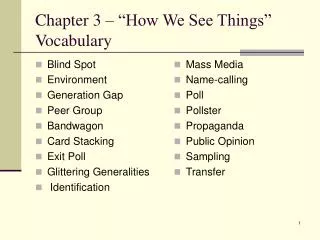
Chapter 3 – “How We See Things” Vocabulary
180 likes | 356 Vues
This resource explores the fascinating world of optical illusions and how they affect our perceptions and interpretations of reality. By examining various examples, such as the "How Many Legs Do You See?" and the "Stare at the Bulb" illusions, we reveal the dynamics of human perception and the cognitive processes that enable us to make sense of ambiguous stimuli. Additionally, we delve into the psychology behind blind spots in our understanding and the social influences that shape public opinion through mass media and propaganda. Engage with interactive illusions and enhance your awareness of how we perceive the world.


Chapter 3 – “How We See Things” Vocabulary
E N D
Presentation Transcript
Blind Spot Environment Generation Gap Peer Group Bandwagon Card Stacking Exit Poll Glittering Generalities Identification Mass Media Name-calling Poll Pollster Propaganda Public Opinion Sampling Transfer Chapter 3 – “How We See Things” Vocabulary
Contemporary Issues Optical Illusions / perceptions
How Many Legs do you see? How many legs does this elephant have?
Do you see a duck??? Do you see a bunny???
What do you see? Do you see the baby?
Stare at the black light bulb for at least 30 seconds.Then immediately stare at a white area on the screen or at a sheet of paper. You should see a glowing light bulb!
Stare at the center of the weird flag for about 1 minute.Don't move your eyes. Then look at an empty white sheetof paper, and you'll see the red, white, and blue flag.
This is this cat This is is cat This is how cat This is to cat This is keep cat This is a cat This is dumbass cat This is busy cat This is for cat This is twenty cat This is seconds cat Now go back and read the THIRD wordin each line from the top. Dr. Seuss' Lost Tongue Twister See if you can do this. Read each line aloud.
I cdnuolt blveiee taht I cluod aulacltyuesdnatnrd waht I was rdgnieg. The phaonmneal pweor of the hmuan mnid Aoccdrnig torscheearch at Cmabrigde Uinervtisy, it deosn't mttaer in waht oredr the ltteers in a wrod are,the olny iprmoatnt tihng is taht the frist and lsat ltteer be in the rghit pclae. The rset can be a taotl mses and you cansitll raed it wo uthit a porbelm. Tihs is bcuseae the huamn mnid deos not raed ervey lteter by istlef, but the wrod as a wlohe. Amzanig huh? Believe it or not, you can read it.
Moving Optical Illusions • http://www.michaelbach.de/ot/sze_Frankfurter/index.html • http://www.michaelbach.de/ot/ang_hering/index.html • http://www.michaelbach.de/ot/mot_adaptSpiral/index.html • http://www.michaelbach.de/ot/col_lilacChaser/index.html • http://kids.niehs.nih.gov/illusion/illusions.htm • http://www.optillusions.com/dp/1-42.htm • http://www.optillusions.com/dp/1-41.htm • http://www.optillusions.com/dp/1-62.htm • http://www.optillusions.com/dp/1-26.htm • http://www.patmedia.net/marklevinson/cool/cool_illusion.html
Rotational Illusions (3) • http://www.michaelbach.de/ot/cog_rotations/index.html