SlideServe
Menu
Préférences
© SlideServe · v2026

Overview of Methods for Measuring Vaporization Enthalpies: Techniques and Correlations

magda avatar
21 diapositives · 356 Views · Aug 07, 2014

This document presents a comprehensive summary of various methods used to measure vaporization enthalpies, including calorimetry, manometry, gas chromatography, and others. Key techniques such as Calvet calorimetry, headspace analysis, and the use of gauges (e.g., Bourdon, McLeod, and Heise) are discussed. We explore correlations in gas chromatography and how they relate to the enthalpies of vaporization through thermochemical cycles. Detailed equations and parameters used for measurement are provided to assist in understanding the process of determining vapor pressures.
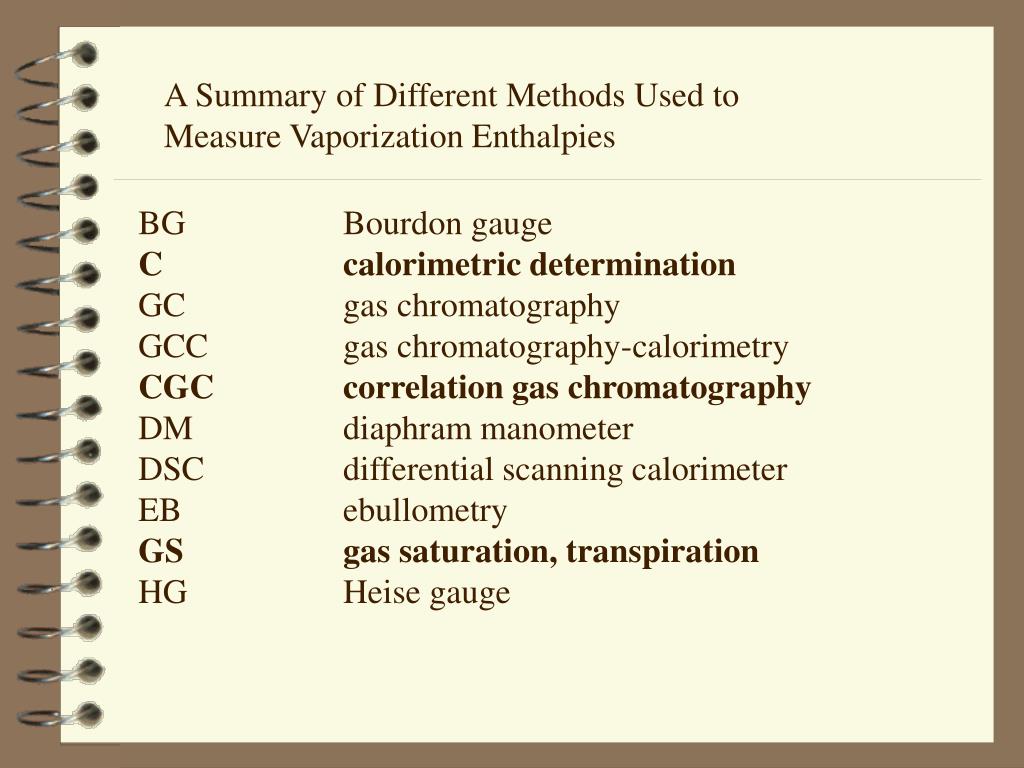
Overview of Methods for Measuring Vaporization Enthalpies: Techniques and Correlations - slide 1
01 / 21Overview of Methods for Measuring Vaporization Enthalpies: Techniques and Correlations
1 / 17

Télécharger la présentation

Overview of Methods for Measuring Vaporization Enthalpies: Techniques and Correlations
Une image / un lien ci-dessous est fourni (tel quel) pour télécharger la présentation

Politique de téléchargement : le contenu du site vous est fourni TEL QUEL pour votre information et votre usage personnel ; il ne peut être vendu, concédé sous licence ni partagé sur d’autres sites sans l’accord de son auteur.Le contenu vous est fourni TEL QUEL, pour votre information et votre usage personnel uniquement. Téléchargez la présentation en cliquant sur ce lien. Lors du téléchargement, si vous ne parvenez pas à télécharger une présentation, l’éditeur a peut-être supprimé le fichier de son serveur.Pendant le téléchargement, si vous ne parvenez pas à obtenir une présentation, le fichier a peut-être été supprimé par l’éditeur.

F I N

Plus de contenu associé

Transcription de la présentation
  1. A Summary of Different Methods Used to Measure Vaporization Enthalpies BG Bourdon gauge C calorimetric determination GC gas chromatography GCC gas chromatography-calorimetry CGC correlation gas chromatography DM diaphram manometer DSC differential scanning calorimeter EB ebullometry GS gas saturation, transpiration HG Heise gauge

  2. A Summary of Different Methods Used to Measure Vaporization Enthalpies (continued) HSA head space analysis I isoteniscope IPM inclined piston manometry ME Mass effusion-Knudsen effusion MG McLeod gauge MM mercury manometer OM oil manometer RG Rodebush gauge SG spoon gauge STG strain gauge T tensimeter TE torsion effusion UV ultraviolet absorption

  3. TB thermobalance TGA thermal gravimetric analysis TPTD temperature programmed thermal desorption particle beam mass spectrometry TRM thermoradiometric method TSGC temperature scanning gas chromatography UV ultraviolet absorption HSA V viscosity gauge VG MKS Baratron Vacuum Gauge

  4. Measurement of Vaporization Enthalpies 1. Measurement of vapor pressure as a function of temperature - using a manometer 2. Knudsen effusion P = m(2RT/mw)1/2/ t AKc Kc = 8r/(3l +8r) where: P = pressure; m = mass loss from cell; t = period of time; A = area of opening mw = molecular weight; T = temperature (K) r = radius of opening; l = thickness of opening

  5. 3. Calvet calorimeter 4. Transpiration 5. Head space analysis 6. Correlation gas chromatography

  6. Correlation gas chromatography

  7. What is ta? ta is theadjusted retention time ti - tnrr ti = retention time of ith component tnrr = retention time of a non retained reference What does ta measure?

  8. For a pure component, a plot of ln (vapor pressure) vs 1/T over a narrow temperature range results in a straight line. The slope of the line is equal to - glHm(Tm), the enthalpy of vaporization. A plot of ln (1/ ta) vs 1/T over a narrow temperature range results in a straight line. What does the slope measure?

  9. Enthalpy of Transfer Determination for Tetradecane ln(1/ta) = -gslnHm(Tm)/R + intercept gslnHm(Tm) * 8.314 J mol-1 = 53.158 kJ mol-1

  10. What isslngHm(Tm) ? What does it measure? Solute on stationary phase of column  gas phase Thermochemical cycle: Vapor  pure liquid  solution on the capillary column slngHm(Tm) = lgHm(Tm) + slnHm(Tm)

  11. Characteristics of capillary gas chromatographs with FID detectors Typical sample sizes ~ microgram quantities solids or liquids are in “solution” or adsorbed; concentrations are low and too dispersed for crystallization temperatures are also high for crystals to form

  12. Equations for the temperature dependence of ln(1/ta) for C14 to C20:

  13. lgHm (298.15 K) = (1.4360.019) slngHm(Tm) – (4.540.35); r2 = 0.9991

  14. Why doeslgHm (298.15 K) correlate with slngHm(Tm) in a linear fashion? gslnHm(Tm) = glHm(Tm) + slnHm(Tm) We know thatglHm(298.15 K)  4.69 (nC -nQ) + 3.0 However T = 298.15 K is an arbitrary temperature glHm(Tm) = AT (nC) + BT where A is some constant and B is a variable but small in magnitude Lets assume for the moment that slnHm(Tm) = Asln(nC) + Bsln where B is a variable but small in magnitude The slope of the line from the correlation is given by: slope = lgHm (298.15 K) / slngHm(Tm)

  15. slope = lgHm (298.15 K)/slngHm(Tm) slope = [A298 (nC) + B298]/{[AT (nC) + BT]+ Asln(nC) + Bsln} slope = [A298 (nC) + B298]/{(AT + Asln)(nC) + (BT + Bsln)} let A’ = (AT + Asln); B’= (BT + Bsln) slope =/[A298 (nC) + B298]/{(A’)(nC) + (B’)} if = (A’)(nC) > B’ and A298 > B298 then slope = (A298)/(A’) = constant

  16. Ruzicka, K.; Majer, V. “Simultaneous treatment of vapor pressures and related thermal data between the triple point and normal boiling temperatures for n-alkanes C5-C20,” J. Phys. Chem. Ref. Data1994, 23, 1-39. Table 4. Parameters of the Cox Equation. Tb Ao 103A1 106A2 tetradecane 526.691 3.13624 -2.063853 1.54151 pentadecane 543.797 3.16774 -2.062348 1.48726 hexadecane 559.978 3.18271 -2.002545 1.38448 heptadecane 575.375 3.21826 -2.04 1.38 octadecane 590.023 3.24741 -2.048039 1.36245 nonadecane 603.989 3.27626 -2.06 1.35 eicosane 617.415 3.31181 -1.02218 1.34878 Cox Equation ln (p/po) = (1-Tb/T)exp(Ao +A1T +A2T 2)

  17. Hv(298) Hv(lit) (449) HslnvHsln tetradecane 71.7 56.909 53.2 -3.709 pentadecane 76.8 60.701 56.4 -4.301 hexadecane 81.4 64.485 60.3 -4.185 heptadecane 86.5 68.171 63.3 -4.871 octadecane 91.4 72.092 66.6 -5.492 nonadecane 96.4 75.998 70.3 -5.698 eicosane 101.8 79.793 74.2 -5.593

  18. lgHm(T)/ kJ mol-1= 3.816nC+3.43 slnHm(T)/ kJ mol-1= 0.34816nC+1.08

  19. lgHm(449 K) / kJ mol-1= 3.82nC+3.43 slnHm (449 K) / kJ mol-1= -0.35nC+1.08 lgHm(298.15 K) / kJ mol-1= 4.98nC+1.88 lgHm(298.15 K)/slngHm(449 K) = (4.98nC+1.88)/(3.82nC+3.43- 0.35nC+1.08) lgHm(298.15 K)/slngHm(449 K)= 4.98/(3.47) = 1.435 lgHm (298.15 K) / slngHm(Tm) = (1.4360.019)