Download
1 / 17
170 likes | 303 Vues
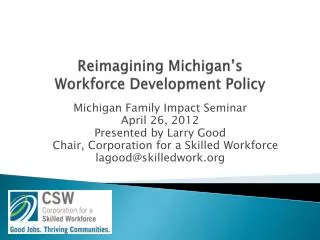
The Michigan Family Impact Seminar on April 26, 2012, presented by Larry Good, Chair of the Corporation for a Skilled Workforce, explores the urgent need to revamp Michigan's workforce development policies. Amidst a transforming economy, this seminar highlights critical challenges such as declining per capita income, rising long-term unemployment, and skills shortages among workers. It emphasizes increasing educational attainment and fostering partnerships between industry and education to align workforce capabilities with market demands. Innovative approaches and lifelong learning are essential for building a skilled workforce.

E N D
Reimagining Michigan’sWorkforce Development Policy Michigan Family Impact Seminar April 26, 2012 Presented by Larry Good Chair, Corporation for a Skilled Workforce lagood@skilledwork.org
Why Reimagine Workforce Development? • Michigan’s economy is in the midst of transforming - as is the nation’s • Federal workforce investment laws & programs were designed before the Internet – solutions for a different era
Challenges are very large • Michigan workers are getting poorer – 36th in per capita income • 100,000 Michigan workers have been unemployed for a year or longer – a level not seen since the Depression • At same time, we see daily headlines about employers who can’t find workers with skills they need
Educational attainment matters… • Higher educational attainment results in higher earnings • 62% of Michigan’s 2018 jobs will require a post-secondary credential Opportunity in the new economy requires workers to possess a post-secondary degree or certificate.
…and Michigan is lagging, not leading • 36% of working-age adults have associate’s degree or higher • Puts Michigan below national average • Percentage is improving, but far too slowly • 23% for blacks; 21% for Hispanics, Native Americans • 1 out of 3 working age adults lack essential basic skills • Worse than national average • Essentially blocked from paths to good jobs now
Michigan’s workforce imperative: Increasing educational attainment of post-secondary degrees and certificates
Need is academic AND technical • Michigan needs more workers with varying levels and types of post-secondary credentials: • PhD’s, Master’s and Bachelor’s Degrees important • But so are technical skill credentials • Technical, industry-used certificates can carry high market value
7 Principles for Workforce Investment Public Policy • Increase educational attainment • Substantially improve career navigation • Operate through industry-education sector/cluster partnerships • Embrace innovation to accelerate learning • Embrace continuing learning & change • Operate at speed of global economy • Reinvest in adult & post-secondary education
Increase educational attainment • Urgency • In states moving faster than Michigan, guiding coalition drives this as an imperative • Set a clear goal - and measure progress towards it • Lumina’s 60% by 2025 • Undertake combination of strategies • Increase completion of degrees once started • Increase flow from Adult Basic Ed to degrees • Focus on retraining for working adults • Target increasing attainment for persons of color
2. Improve career navigation • Disinvestment in counseling/advising • Victim of budget cuts in every system • No one’s “core business” • Lots of noise, hard to navigate • Tons on web sites; not clear what to trust • Hard to keep up with speed of industry changes • Need “hi tech, hi touch” combination • Web sites that are current, accurate, easy to use • Cadre of skilled navigators
3. Operate Thru Industry-Education Sector/Cluster Partnerships • Big, new approach to workforce development • Organize groups of employers from industry with educators to define needs and create solutions • Focus both on meeting employer needs and providing career paths for workers • Industry partnerships work • Improve employer results – turnover, rework • Improve worker results – increased earnings • Momentum in Michigan • Regional Skills Alliances • State Cluster Teams
4. Embrace Innovation to Accelerate Learning • Speed matters • Michigan can’t meet a 60% goal without it • Workers need it given income needs • Become a Promising Practices Leader • Lots of innovations in other states to build upon • Michigan needs to become a leading experimenter • Accelerate learning • Get out of “semesters only” box • Build basic skills within context of occupational training – simultaneously • Expand uses of online learning
5. Embrace Continuing Learning & Change • Lifelong Learning: rhetoric to reality • Speed of global change demands it • Only lifelong learners will keep pace • Value adaptability • Get smart about how to translate what someone knows into readiness for new jobs that emerge • Embrace change, don’t hide from it
6. Operate at Speed of Global Economy • Public programs change too slowly • Operate in multi-year planning cycles • Most major changes take years to effect • Most companies now change swiftly or die • Autos as a “before/after” example • Microsoft struggling to sustain their dominance • Reinvent how workforce agencies & colleges operate • Increase speed of decision-making, action • Western Governors University example
7. Reinvest in Adult & Post- Secondary Education • Scale of Disinvestment Has Been Tragic • We’ve moved from being a leading state to a bottom of the list state in every segment – adult ed, community colleges, universities • Without changing that, Michigan cannot achieve the educational attainment we urgently need
Undertaking a campaign of scalable improvement • Michigan needs to tackle this at the “race to the moon” level of urgency, investment and commitment. • Each of the last (at least) five governors have named increasing educational attainment as a crucial goal. • Lots of blue ribbon commissions, projects • Issue now is tackling and sustaining action
Example: No Worker Left Behind • Major initiative by Gov. Granholm • Offered up to two years of free post-secondary education to unemployed and low-income workers • Had to result in credential valued by employers • Without major marketing, 160,000 enrolled Michigan workers are ready to embrace lifelong learning – if its visible, accessible, affordable