The Evolution of Calm Computing: Embracing Ubiquitous Technology in Daily Life
In "The Computer for the 21st Century," Mark Weiser advocates for calm technology that integrates seamlessly into human environments, enhancing user experience without intrusion. The shift from mainframes to personal computing and now to ubiquitous computing illustrates our need for technology that respects our surroundings. Calm computing aims to improve our peripheral awareness while minimizing attention demands. Exploring concepts like perceptual invisibility and infrastructural invisibility, we discuss the challenges and potential of creating technology that informs and calms us simultaneously.

The Evolution of Calm Computing: Embracing Ubiquitous Technology in Daily Life
E N D
Presentation Transcript
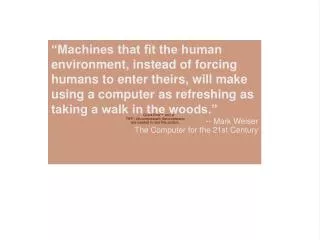
“Machines that fit the human environment, instead of forcing humans to enter theirs, will make using a computer as refreshing as taking a walk in the woods.” -- Mark Weiser The Computer for the 21st Century
Calm Computing Hari Khalsa September 20, 2004
The Coming Age of Calm Technology By Mark Weiser and John Seely Brown, 1996 • What has come before • Mainframe - many people share one computer • PC - one person, one computer • Internet - transition to ubiquitous computing • Calm Technology • Utilize a user’s periphery • Come to center only when necessary • Enhance peripheral reach to keep people tuned in to surroundings without demanding attention • Examples • Inner office windows connect people to nearby world • Dangling string connects people to network usage • But why?
Unremarkable Computing By Peter Tolmie, James Pycock, Tim Diggins, Allan MacLean and Alain Karsenty, 2002 • Making technology “invisible in use” • Routines • Done in the doing • Knocking on the door has a specific meaning at a specific time • Perceptual visibility and practical invisibility • Alarm clock going off at a specific time starts a routine • Clock has practical invisibility since no one thinks about the clock itself • Do not command attention unless necessary • Routines are calm and generally unspoken • Problems with current approaches • Perceptual invisibility vs. invisibility in use • Augmenting and adding semantics to tangible artifacts can confuse • Systems intended to support a routine must not ask the user to describe or account for activities • Need more research to create actual designs
Seeing the Invisible By Jeffrey Heer, Peter Khooshabeh • Invisibility in Use • Fades into the conceptual background • Work through tools rather than with them • Example: computer mouse • Often arises from learning and practice • Infrastructural Invisibility • Computation is embedded in environment • Ability of infrastructure to become tacit in thought and action • Interaction is less apparent • Example: plumbing and electrical systems • Invisibility is an experienced relationship between humans and their tools, whether physical or conceptual
Calm vs. Invisible • Invisibility • Invisibility In use • Infrastructural / Perceptual Invisibility • “Calm” computing fits into both • Challenge: making ubiquitous computing calm • Systems that “encalm and inform” simultaneously