Download
1 / 27
270 likes | 368 Vues
This overview covers the history of cell discovery, starting with Robert Hooke's observation of cork cells in 1665, where he first coined the term "cell". It highlights the advances made by Anton von Leeuwenhoek in microscopy and the establishment of Cell Theory by Matthias Schleiden and Theodor Schwann, asserting that all living organisms are composed of cells. The text also distinguishes between prokaryotic and eukaryotic cells, detailing cellular organelles and their functions, such as mitochondria, ribosomes, and the nucleus, providing a fundamental understanding of cell biology.

E N D
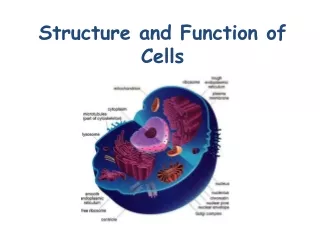
Ch4 p 69 Structure and Function of Cells
History • Robert Hooke – 1665 – Cork cells • First to use the word ‘cell’ to describe the boxes he saw in cork, a plant
History • Anton von Leeuwenhoek – 1673 – Simple Microscopes • Basically a hand lens • Looked at water, poop, muscle tissue, bacteria
History leads to CELL THEORY • Matthias Schleiden – 1838 – All plants are made of cells • Theodor Schwann – 1839 – All animals are made of cells All Combine to form the CELL THEORY: • All living things are made of one or more cells • Cells are the basic unit building block of organisms • Cells only come from other cells
Cells are different • Can be big, little, flat, round • A nerve cell can be 2 meters long!
Cells CAN NOT be that big • Size is limited by its Surface Area to Volume • Surface area is the amount of wrapping paper you need to cover a present • Volume is how much stuff is inside
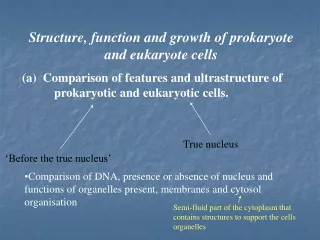
TWO MAIN TYPES OF CELLS • PROKARYOTIC: pro= ‘pre’ • Has NO nucleus • Has NO organelles • Smaller • EUKARYOTIC: • Has a nucleus • Has organelles • Larger • Complex
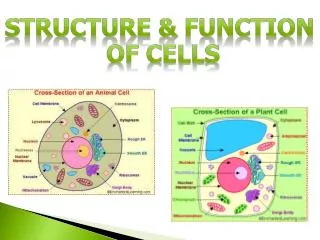
Organelles that we care about: • Nuclear envelope • Ribosome • Flagella • Rough ER • Smooth ER • Golgi • DNA • Lysosomes • Centrioles • Cell wall • Vacuole • Cell membrane • Chloroplast • Mitochondria • Cytoskeleton • Nucleolus • Cytoplasm
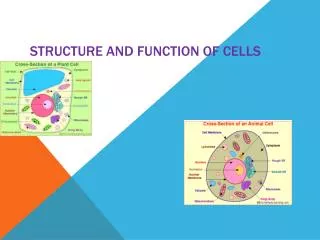
ORGANELLES = Animal Cell Parts 1. Nucleus • Control center • Surrounded by nuclear membrane • Nuclear Pore – a door to let information out of the nucleus • Contains DNA • DNA is also known as chromosomes or chromatin • Is the actual directions for building the cell and the organism • Codes for (instructions) PROTEINS • Nucleolus • Where ribosomes are made
ORGANELLES = Animal Cell Parts 2. Mitochondria • Changes your food into energy called ATP • ‘MIGHTY MITOCHONDRIA’ • Where respiration takes place 3. Ribosomes • RRR = Ribosomes READ RNA and make Proteins • They help direct how to make a protein • Can be attached to the ER or floating in the cytoplasm
ORGANELLES = Animal Cell Parts 4. Endoplasmic Reticulum • Can be smooth – no ribosomes connected • Or rough – ribosomes stuck on it • Where chemicals and proteins are made and wrapped in a membrane – MAKES THINGS • Looks like a warm lava lamp 5. Golgi Apparatus • Fixes proteins to be sent out of the cell • GOLGI = FEDEX
ORGANELLES = Animal Cell Parts 6. Lysosomes • Break down old cell parts • Break down food 7. Cytoskeleton • Made of: • Microfilaments • Microtubules • Sticks that provide support • Help move parts around the cell, like roads • Become SPINDLE FIBERS for cell division
ORGANELLES = Animal Cell Parts 8. Cilia or Flagella • Hair like organelles • MOVEMENT 9. Centrioles • Helps direct cell division 10. Cell Membrane • SEMIPERMEABLE – ‘picky’ • Selectively permeable • PhospholipidBilayer
CELL MEMBRANE 10. Cell Membrane • SEMIPERMEABLE – ‘picky’ • Selectively permeable • PhospholipidBilayer • Hydrophobic tail • Hydrophilic head
ORGANELLES = Plant Cell Parts 11. Vacuole • Holds water, and minerals • Largest part of the plant cell 12. Cell Wall • Structure of the plant 13. Chloroplast • PHOTOSYNTHESIS • Uses sunlight and carbon dioxide to make glucose