Development of a Continuous Solvent Exchange Process using Microfluidics and Membrane Technology
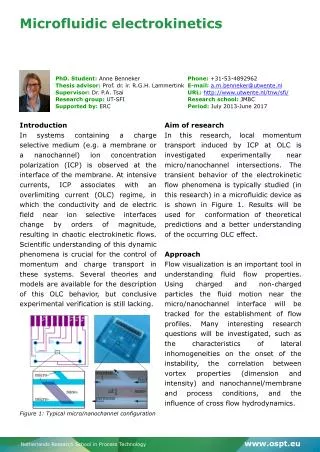
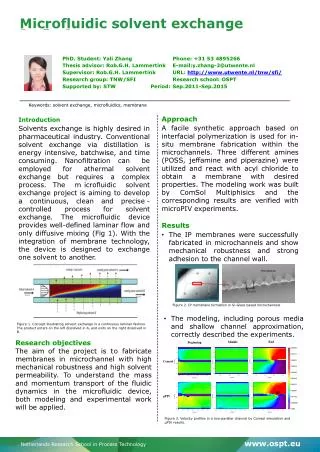
This research project focuses on advancing a continuous, efficient, and precise solvent exchange process in the pharmaceutical industry, minimizing energy consumption and time compared to traditional distillation methods. Utilizing a microfluidic device designed for laminar flow and diffusive mixing, the study employs interfacial polymerization for in situ membrane fabrication within microchannels. The study leverages modeling via ComSol Multiphysics and validates results with micro-PIV experiments, showcasing the mechanical robustness and effective solute transport of the newly developed membranes.

Development of a Continuous Solvent Exchange Process using Microfluidics and Membrane Technology
E N D
Presentation Transcript
Microfluidic solvent exchange Comsol Front Middle End µPIV PhD. Student: Yali Zhang Phone: +31 53 4895266 Thesis advisor: Rob.G.H. Lammertink E-mail:y.zhang-2@utwente.nl Supervisor: Rob.G.H. Lammertink URL: http://www.utwente.nl/tnw/sfi/ Research group: TNW/SFI Research school: OSPT Supported by: STW Period: Sep.2011-Sep.2015 Keywords: solvent exchange, microfluidics, membrane • Introduction • Solvents exchange is highly desired in pharmaceutical industry.Conventional solvent exchange via distillation is energy intensive, batchwise, and time consuming. Nanofiltrationcanbeemployed for athermal solvent exchange but requires a complex process. Themicrofluidicsolventexchangeprojectisaimingtodevelopacontinuous,cleanandprecise-controlledprocessforsolventexchange.Themicrofluidicdeviceprovides well-defined laminar flow and only diffusive mixing(Fig1). With the integration of membrane technology, the device is designed to exchange one solvent to another. • Approach • A facile synthetic approach based on interfacial polymerization is used for in-situ membrane fabrication within the microchannels. Three different amines (POSS, jeffamine and piperazine) were utilized and react with acyl chloride to obtain a membrane with desired properties.The modelingwork was built byComSolMultiphisicsand the correspondingresults are verifiedwith microPIV experiments. • Results • The IP membranes were successfully fabricated in microchannels and show mechanical robustness and strong adhesion to the channel wall. Solute X Solute X Membrane Figure2. IP membrane formation in Si-Glass based microchannels • The modeling, including porous media and shallow channel approximation, correctly described the experiments. 20μm Figure 1. Concept illustrating solvent exchange in a continuous laminar fashion. The product enters on the left dissolved in A, and exits on the right dissolved in B. Middle Beginning Research objectives Theaim of the projectistofabricatemembranesinmicrochannelwith high mechanical robustness and high solvent permeability. To understand the mass and momentum transport of the fluidic dynamics in the microfluidic device, both modeling and experimental work will be applied. End Figure3. Velocity profiles in a two-parallar channel by Comsolsimulation and µPIV results.