The Dual Role of Organic Matter in Mercury Cycling: Implications for Microbial Reduction
This study explores the dual role of dissolved natural organic matter (DOM) in the cycling of mercury (Hg) in anoxic environments. It focuses on how microbial reduction of Hg(II) is connected to DOM, highlighting that while DOM can reduce Hg(II) to elemental Hg(0), it also complexes with mercury, impacting the production of Hg(0). The research emphasizes the significance of the sulfur redox state in DOM and the DOM:Hg ratio on Hg transformation and potential microbial production of toxic methylmercury.

The Dual Role of Organic Matter in Mercury Cycling: Implications for Microbial Reduction
E N D
Presentation Transcript
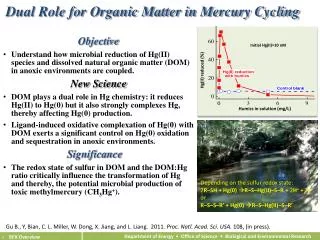
Dual Role for Organic Matter in Mercury Cycling Initial Hg(II)=10 nM • Objective • Understand how microbial reduction of Hg(II) species and dissolved natural organic matter (DOM) in anoxic environments are coupled. • New Science • DOM plays a dual role in Hg chemistry: it reduces Hg(II) to Hg(0) but it also strongly complexes Hg, thereby affecting Hg(0) production. • Ligand-induced oxidative complexation of Hg(0) with DOM exerts a significant control on Hg(0) oxidation and sequestration in anoxic environments. • Significance • The redox state of sulfur in DOM and the DOM:Hg ratio critically influence the transformation of Hgand thereby, the potential microbial production of toxic methylmercury (CH3Hg+). Hg(II) reduced (%) Humics in solution (mg/L) Depending on the sulfur redox state: 2R–SH + Hg(0)R–S–Hg(II)–S–R + 2H+ + 2e- or R–S–S–R’ + Hg(0) R–S–Hg(II)–S–R’ Gu B., Y, Bian, C. L. Miller, W. Dong, X. Jiang, and L. Liang. 2011. Proc. Natl. Acad. Sci. USA. 108, (in press). Department of Energy • Office of Science • Biological and Environmental Research 1BER Overview