Investigating Tillage Effects on Soil Health and Ecosystem through Collaborative Research in Iowa
This project, based in Cedar Falls/Waterloo and Blackhawk County, Iowa, examines the impacts of tillage practices on soil health and local ecosystems. Using a simple land-surface model (GAPS), researchers aim to address several scientific questions: How does tillage affect soil erosion? What are the temperature differences between tilled and no-till fields? Are hummingbirds influenced by tillage in their habitat choices? This collaborative initiative involves GLOBE scientists, students, and community members to better understand tillage effects and promote sustainable farming practices.

Investigating Tillage Effects on Soil Health and Ecosystem through Collaborative Research in Iowa
E N D
Presentation Transcript
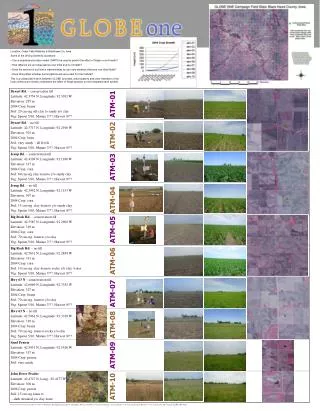
Location: Cedar Falls/Waterloo & Blackhawk Co, Iowa • Some of the driving Scientific Questions: • Can a simple land-surface model (GAPS) be used to predict the effect of tillage on soil health? • How different are air temperatures over tilled and no-till fields? • Does the amount of soil that is washed away by rain vary between tilled and non-tilled fields? • Does tilling affect whether hummingbirds will use a field for their habitat? • This is a collaborative effort between GLOBE scientists, area students and other members of the local community to better understand the effect of tillage practice on the integrated earth system. ATM-01 ATM-02 ATM-03 ATM-04 ATM-05 ATM-06 ATM-07 ATM-08 ATM-09 ATM-10 Project web site: www.globe.gov/globeone; Photos: Washburne, McLaughlin; Site installation: McLaughlin, Hiemstra, Washburne, Noack; Site maintenance: Noack; Orthophotos: Iowa Geographic Image Map Server, ortho.gis.iastate.edu/; Major funding: GLOBE, NSF, NASA