FVTX Data Acquisition System
This document outlines the engineering approach adopted by the RF Engineering Group to address the challenges of transporting data from detectors to the PHENIX data collection system. Key considerations include meeting strict data transport requirements, ensuring signal integrity amidst high radiation exposure, and adhering to mechanical and thermal constraints. The system is designed to be fully compatible with existing PHENIX infrastructure while achieving optimal data capture rates and maintaining radiation tolerance. The next steps include demonstrating high-speed optical links and full system integration.

FVTX Data Acquisition System
E N D
Presentation Transcript
FVTX Data Acquisition System Mark Prokop Accelerator Operation &Technology Division RF Engineering Group
Introduction • Overview of the Engineering Problem • System • Implementation • Concluding remarks
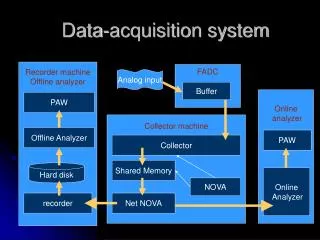
Engineering Problem • Transport data from the detectors to the PHENIX data collection system • Meet requirements • Abide with the constraints
Requirements • Physics • Signal-to-noise, radiation length • data capture and integrity • Timing • LVL-1 • DCM • Radiation • 100k-200k Rad Integrated dose over 10 years • 1.0x10⁻⁷ to 1.6x10⁻⁵ /bit/hour upset rates • Physical
Constraints • Mechanical • Thermal • PHENIX System • Data Collection rates • Collocated with VTX • IR Shared with other detector systems • PHENIX Environment • Noise • Magnetic Fields • Interference
System Design Approach • Radiation Tolerance to 20kRad • Radiation immunity for FPGA configuration data • Built-in test and diagnostics • B-Field Immunity • Flexible Grounding options • EMI environment tolerant • Moderate design challenge • Compatible with existing PHENIX data collection system • Meet LVL-1 timing
ROC Features • Radiation tolerant FPGA and SERDES • Combines data from 52 FPHX chips • Synchronization • Removal of sync words • ~17:1 data rate reduction
FEM Features • VME Based • Xilinx FPGA • 4 FEMs per VME card • 1:1 FEM to ROC ratio • Store data by BCO clock and buffer for 64 BCO clocks • Combine 4 FEM data streams and transmit to single DCM • ~23:1 data rate reduction
System Performance 1 • No impact on signal-to-noise or radiation length • Capturing all event data • Radiation Tolerance • Immunity to configuration upsets • Fits Mechanical and Thermal Design Parameters • Fully Compatible with PHENIX Data systems • Meets LVL-1 Timing • Meets DCM Data requirements
System Performance 2 • Sensor-to-ROC interconnect designed for EMI environment • Co-Designed with VTX • Designed for immunity to B-field • Fully compatible with existing PHENIX data collection system
Concluding Remarks • Status • Next steps
Current Status • Demonstrated ROC and FEM functionality • System data collection requirements analyzed: LVL-1 and DCM requirements met • No critical R&D issues for electronics hardware
Next Steps • Demonstrate 2.5 Gbit/sec FO Link • Full up Prototype ROC, FEM and FO communications including integration with PHENIX data collection system (DCM) • Engineering systems electronics and interconnections for Noise, EMI and Grounding requirements