SlideServe
Menu
Préférences
© SlideServe · v2026

Understanding Participles in English and Latin

malina avatar
12 diapositives · 219 Views · Jul 22, 2014

Learn the concept of participles, how they function as verbal adjectives, and how to form present participles in both English and Latin languages.
Understanding Participles in English and Latin - slide 1
01 / 12Understanding Participles in English and Latin
1 / 17

Télécharger la présentation

Understanding Participles in English and Latin
Une image / un lien ci-dessous est fourni (tel quel) pour télécharger la présentation

Politique de téléchargement : le contenu du site vous est fourni TEL QUEL pour votre information et votre usage personnel ; il ne peut être vendu, concédé sous licence ni partagé sur d’autres sites sans l’accord de son auteur.Le contenu vous est fourni TEL QUEL, pour votre information et votre usage personnel uniquement. Téléchargez la présentation en cliquant sur ce lien. Lors du téléchargement, si vous ne parvenez pas à télécharger une présentation, l’éditeur a peut-être supprimé le fichier de son serveur.Pendant le téléchargement, si vous ne parvenez pas à obtenir une présentation, le fichier a peut-être été supprimé par l’éditeur.

F I N

Plus de contenu associé

Transcription de la présentation
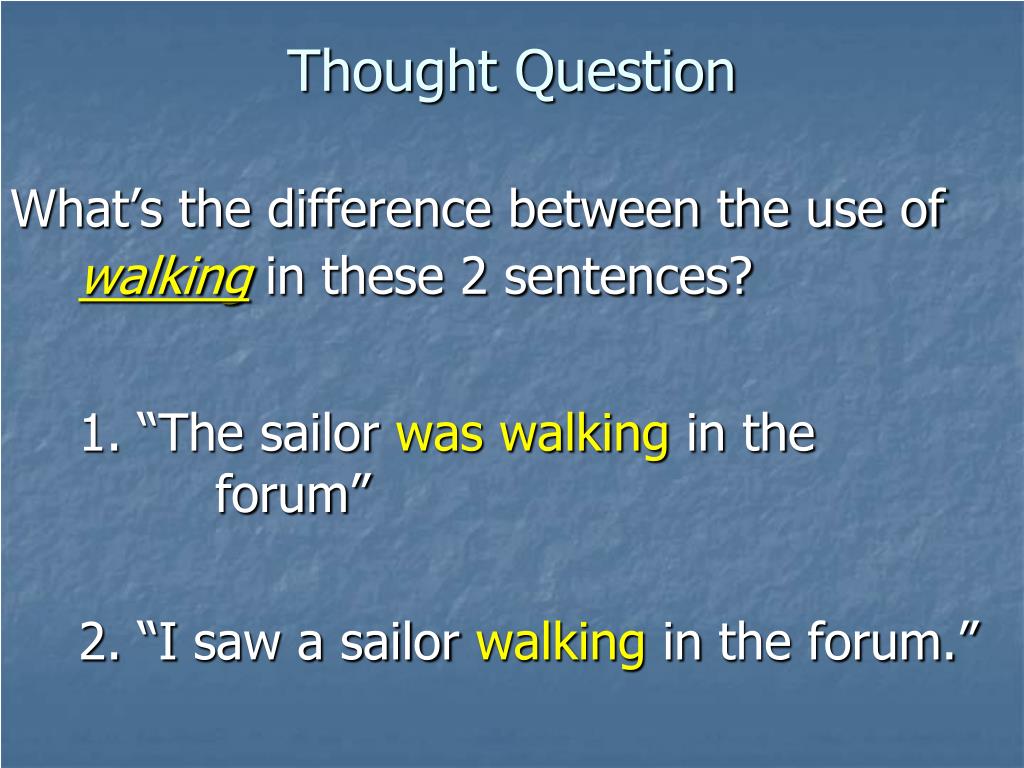
  1. Thought Question What’s the difference between the use of walkingin these 2 sentences? 1. “The sailor was walking in the forum” 2. “I saw a sailor walkingin the forum.”

  2. What is a Participle? A participle is a verbal adjective. In other words, it’s a verb that is turned into an adjective.

  3. In English • For present participles, we usually add an ‘-ing’ to the end of a Verb to make a Participle. • Can you give me examples?

  4. What does the participle do? What does a participle tell us? The singing poet The ruling king The learning student The student learning the present participle running bull laughing cow The people running in the streets are crazy.

  5. Which words do you think are Participles in the Latin? Given these two participles, what markers does Latin have for the Participle? (like the ‘ing’ in English)

  6. Which words do you think are Participles in the Latin? Yes, it’s the ‘-nt’ before an ending.

  7. How to Form Present Participles • Go to the second principal part of 1st, 2nd and regular 3rd conjugation verbs. • Drop the ‘-re’ • Add ‘-ns’ and ‘-ntis’ for the nominative and genitive singular forms. The rest of the cases decline like a 3rd Declension Adjective. Examples: amare: amans, amantis, amanti, amantem, amanti (-e) manere: manens, manentis, manenti, manentem, agere: agens, agentis, agenti, agentem, etc.

  8. How to Form Present Participles • Go to the second principal part, and drop the ‘-re’. • Add: Nom. -ns -ntes (-ntia) Gen. -ntis -ntium Dat. -nti -ntibus Accus. -ntem (-ns) -ntes (-ntia) Abl. -nti /-nte -ntibus

  9. -io Verb Exception • Go to the second principal part. • Drop the ‘-ere’ or the ‘-ire’ • Add ‘-iens’ and ‘-ientis’ for the nominative and genitive singular forms. The rest of the cases decline like a 3rd Declension Adjective. Examples: fugio, fugere: fugiens, fugientis, fugienti, etc. audio, audire: audiens, audientis, audienti, audientem, etc.

  10. -io Verb Exception • Go to the second principal part, and drop the ‘-ere’ or the ‘-ire’ • Add: Nom. -iens -ientes (-ientia) Gen. -ientis -ientium Dat. -ienti -ientibus Accus. -ientem (-iens) -ientes (-ientia) Abl. -ienti /-iente -ientibus

  11. The Key in Translation If you see a verb stem with an ‘ns’ or an ‘nt’ before a 3rd Declension ending, you know you’re dealing with a Present Participle.

  12. A participle can have an object rex cenam edens = The king eating dinner The king who is eating dinner