Machine Learning Hidden Markov Model
This seminar, presented by Darshana Pathak at the University of North Carolina at Chapel Hill on November 14, 2012, delves into the principles of Machine Learning and Hidden Markov Models (HMM). It discusses the concept of enabling computers to learn from experience without explicit programming and addresses the need for advanced data processing capabilities. Detailed distinctions between Machine Learning and Data Mining are provided, alongside practical applications of HMM in areas like error generation, speech recognition, and medical data analysis, emphasizing the challenges and methodologies involved.

Machine Learning Hidden Markov Model
E N D
Presentation Transcript
Machine Learning Hidden Markov Model DarshanaPathak University of North Carolina at Chapel Hill Research Seminar – November 14, 2012
Disclaimer All the information in the following slides assumes that “There is a GREAT human mind behind every computer program.”
What is Machine Learning? • Make Computers learn from a given task and experience. • “Field of study that gives computers the ability to learn without being explicitly programmed”. • Arthur Samuel (1959)
Why Machine Learning? • Human Learning is terribly slow! (?) • 6 years to start school, around 20 more years to become cognitive /computer scientist... • Linear programming, calculus, Gaussian models, optimization techniques and so on…
Why Machine Learning? • No copy process in human beings - ‘one-trial learning’ in computers. • Computers can be programmed to learn – Both human and computer programs make errors, error is predictable for computer, we can measure error.
Some more reasons… • Growing flood of electronic data – Machines can digest huge amounts of data which is not possible for human. • Supporting computational power is also growing! • Data mining – to help improve decisions • Medical records study for diagnosis • Speech/handwriting/face recognition • Autonomous driving, robots
Important Distinction • Machine learning focuses on prediction, based on known properties learned from the training data. • Data mining focuses on the discovery of (previously) unknownproperties on the data. • Example: Purchase history/behavior of a customer.
Hidden Markov Model
Hidden Markov Model -HMM • A Markov model with hidden states. • Markov Model – Stochastic Model that assumes Markov property. • Stochastic model – A system with stochastic process (random process).
HMM – Stochastic model • Stochastic process vs. Deterministic process. • SP is probabilistic counterpart of DP. • Examples: • Games involving dice and cards, coin toss. • Speech, audio, video signals • Brownian motion • Medical data of patients • Typing behavior (Related to my project)
HMM – Markov Model • Markov Model – Stochastic Model that assumes Markov property. • Markov property Memory-less property • Future states of the process depend only upon the present state, • And not on the sequence of events that preceded it.
Funny example of Markov chain • 0 – Home; 4 – Destination • 1,2,3 corners;
Hidden Markov Model - HMM • A Markov model with hidden states – Partially observable system.
HMM • Markov process is hidden, we can see sequence of output symbols (observations).
HMM: Simple Example • Determine the average annual temperature at a particular location over a series of years (Past when thermometers were not invented). • 2annual temperatures, Hot – H and Cold - C. • A correlation between the size of tree growth rings and temperature. • We can observe Tree ring size. • Temperature is unobserved – hidden.
HMM – Formation of problem • 2 hidden states – H and C • 3 observed states – tree ring sizes. Small – S, Medium – M, Large – L. • The transition probabilities, observation matrix and initial state distribution. • All matrices are row stochastic.
HMM – Formation of problem • Consider a 4 year sequence. • We observe the series of tree rings S;M; S; L. O = (0, 1, 0, 2) • We need to determine temperature (H or C) for these 4 years i. e. Most likely state sequence of Markov process given observations.
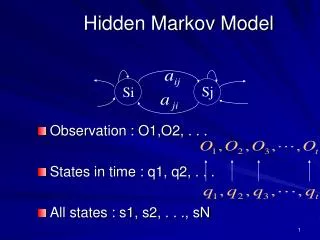
HMM – Formation of problem • X = (x0, x1, x2, x3) • O = (O0, O1, O2, O3) • A = State transition probability (aij) • B = Observation probability matrix (bij)
HMM – Formation of problem • aij = P(state qjat t + 1 | state qiat t) • Bj(k) = P(observation k at t | state qj at t) • P(X) = πx0 * bx0(O0) * ax0,x1 * bx1(O1) * ax1,x2 * bx2(O2) * ax2,x3bx3(O3) • P(HHCC) = 0.6(0.1)(0.7)(0.4)(0.3)(0.7)(0.6)(0.1) = 0.000212
Applying HMM to Error Generation • Erroneous data in real-world data sets • Typing errors are very common. • Insertion • Deletion • Replace • Is there any way to determine most probable sequence or patterns of errors made by typist?
Applying HMM to Error Generation • Examples: 1. BRIDGETT and BRIDGETTE 2. WILLIAMS and WILIAMS 3. LATONYA and LATOYA 4. FREEMAN and FREEMON
Applying HMM to Error Generation • Sequence of characters/Alignment Problem
HMM & Error Generation • Hidden states: Pointer positions • Observations: Output character sequence • Problems: • Finding Path - Given an input, output character sequence and HMM model, determine most probable operation sequence? • Training - Given n pairs of input and output sequences, what is the model that maximizes probability of output? • Likelihood - Given input, output and the model, determine likelihood of observed sequence.
References • Why should machines learn? – Herbert A. Simon, Department of Computer Science and Psychology, Carnegie-Mellon University, C.I.P. # 425 • http://en.wikipedia.org/wiki/Machine_learning • http://en.wikipedia.org/wiki/Hidden_Markov_model • A Revealing Introduction to Hidden Markov Models – Mark Stamp, Department of Computer Science, San Jose State University