1 / 4

Understanding Rate of Transport for Suspended Load with Averaging Scales

Discover the complexities of calculating the rate of transport for suspended loads while being cautious of averaging scales in both time and space. Learn how to interpret findings and avoid assumptions in sediment flux studies.

mandell
Télécharger la présentation

Understanding Rate of Transport for Suspended Load with Averaging Scales

An Image/Link below is provided (as is) to download presentation Download Policy: Content on the Website is provided to you AS IS for your information and personal use and may not be sold / licensed / shared on other websites without getting consent from its author. Content is provided to you AS IS for your information and personal use only. Download presentation by click this link. While downloading, if for some reason you are not able to download a presentation, the publisher may have deleted the file from their server. During download, if you can't get a presentation, the file might be deleted by the publisher.

E N D

Presentation Transcript


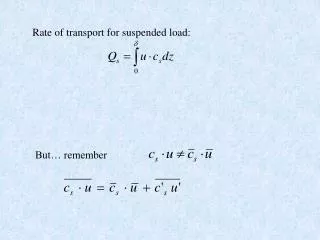
  1. Rate of transport for suspended load: But… remember

  2. Again, we need to be careful of our averaging scales: In the horizontal direction, as both time and space scales get small u’c’ 0 (assuming no gradient in horizontal)

  3. Example: There have been many studies of the coastal current off northern California that find the mean current ( u ) to be directed to the north in the winter. Can we automatically assume that the net flux of sediment is to the north?

  4. No, we can’t say that uc is determined by u c

More Related