Download
1 / 11
110 likes | 229 Vues
This document summarizes a study presented at the QCD Meeting on July 1, 2005, focusing on the strong polarization observed in fixed-target experiments where jets are not noted. The analysis investigates the contributions from various datasets including signal, background, and continuum influences. Progress in data verification, reconstruction, and analysis through CDF software is highlighted, including mass-constrained fits and the examination of asymmetries in different systems. Future plans aim to finalize data analysis and conduct comprehensive polarization studies.

E N D
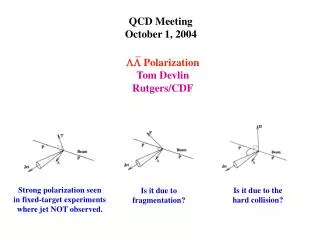
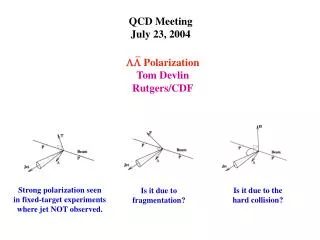
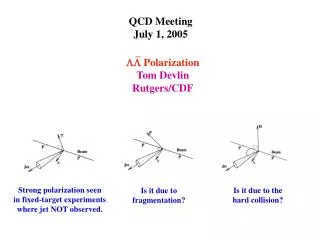
_ Polarization Tom Devlin Rutgers/CDF Strong polarization seen in fixed-target experiments where jet NOT observed. Is it due to the hard collision? Is it due to fragmentation? QCD Meeting July 1, 2005
Status and Plans Three known contributions to dataset: -- Signal -- Ks Background -- Continuum 2-track background Previous report: -- From data, measured relative fractions of these as functions of momentum and decay distance. Run 1 computer – cdfsga – to be shutdown -- Verified that data written by it are correct -- Ran all data through cdfsga, copied to Rutgers -- Thanks to Glenn Cooper and Mike Stolz. Now working with 100% of data at Rutgers!!! -- Real data look reasonable. -- x20 MC is working to a first approximation.
For Each Bin in Momentum and Lxy Evaluate Fractions of , Ks and
Work in Progress and Planned: 2005 • Mass-constrained fits: 2-, 2-Ks, 1-ee. • Sum of weights over solutions = 1.0 per event. • Use 2 = 2(MassConstraint) - 2(NoMassConstraint) • Determine relative proportions of , Ks and background • 5. Modify 2nd stage analysis code to mix MC samples from • , Ks, in correct proportions. • 6. Finish all work on cdfsga. • 7. Do polarization study in all three coordinate systems. • 9. Is polarization analysis believable?