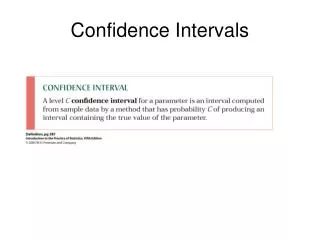
Confidence Intervals
This guide provides essential definitions related to confidence intervals in statistics, including the concepts of estimators, significance levels, and Type I errors. It explains how to compute confidence intervals for a population mean, interpreting results, and common misconceptions. The content emphasizes the importance of understanding probability in relation to confidence intervals and clarifies the statistical saying regarding confidence levels. By exploring these topics, learners can gain a firm grasp of how to quantify uncertainty in estimators effectively.

Confidence Intervals
E N D
Presentation Transcript
Confidence Intervals Chantel Chang Math 480 Dr. Faber
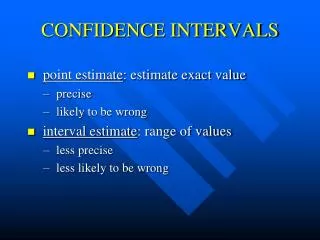
Definitions 1) Estimator: A random variable, , that is a function of a random sample x1,x2,…,xn(e.g. sample mean) 2) Confidence Interval: A range of values that include the unknown parameter, θ(e.g. true population mean, population standard deviation, or population proportion), with probability 1-α. Quantifies uncertainty of estimator. 3) Level of Significance:α, the probability of committing a Type I Error 4) Type I Error: The probability of incorrectly rejecting the null hypothesis
By the Central Limit Theorem, if we have a large enough random sample (>30), then the sample mean, , is approximately normally distributed μ=population mean σ=population s.d. n=sample size • Percent Confidence = 100(1-α)% • 95% confidence interval, α=0.05
Computation of Confidence Interval for the Population Mean 100(1-α)% Confidence Interval
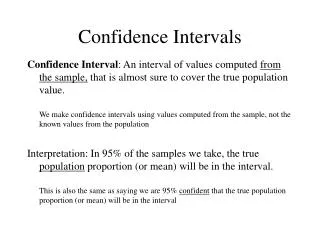
Interpretation of the Confidence Interval 0.05 (error) X 25 = 1.25 For a 95% confidence interval, we should expect to see about one interval that does NOT contain the unknown parameter μ.
Example: Random Number Generator • 5 random numbers generated using FreeMat software, 10 times from a normal distribution with μ=0, andσ=1 x = randn(5,1,10);
For a 95% confidence interval, α=0.05 -Z0.025= -1.96, and by symmetry, Z0.025=1.96 =0.95 0.025= 0.025= 1.96= -1.96=
LB xave LB UB xave LB UB 0.05 (error) X 20 = 1...
Common Misconceptions/ Takeaway!! There is 0.95 probability that the confidence interval [0.0749,1.8280] contains μ. NO! μ=0, so • Before we take any samples, there is a 0.95 probability that a confidence interval will containμ. • Colloquial saying: “We are 95% confident that the interval [0.0749,1.8280] contains μ.” • If we took 100 confidence intervals, we would expect 95 of them to contain μ.