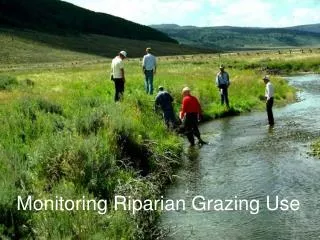
Monitoring Riparian Grazing: Accountability and Sustainability in Land Management
420 likes | 560 Vues
Effective monitoring of riparian grazing practices is essential to ensure accountability, provide feedback on grazing results, and aid decision-making for sustainable land management. Key monitoring approaches include annual assessments, such as tracking actual livestock use, grazing intensity, and plant recovery. Short-term evaluations focus on changes in plant vigor and channel dimensions, while long-term monitoring examines stability in streambanks and plant community shifts. This detailed analysis supports improved practices, promotes ecological health, and enhances riparian areas.


Monitoring Riparian Grazing: Accountability and Sustainability in Land Management
E N D
Presentation Transcript
Why Do We Monitor? • To provide accountability for our actions. • To provide feed back on results. • To aid in our decision making What Should We Monitor? Goals and Objectives
Types of Monitoring • Annual: • Actual use. • Grazing intensity. • Plant recovery. • Short-term (3-5 years): • Point-bars. • Channel width. • Over-hanging vegetation. • Changes in plant vigor. • Long-term : • Channel and bank conditions. • Plant community changes.
Annual Monitoring • Examples of Annual Grazing Use that should be observed and recorded.
Are livestock in the pasture when planned? Are the correct numbers present?
Leave a 4” stubble height on large sedges Observe stubble height-4”
Side (edge) browsing - Booth willow
Short Term Monitoring • The following are examples of typical responses that can be used as indicators of progress towards desired conditions. • These are often useful for short term (2-5 years) monitoring following implementation of improved grazing practices.
Brookgrass acts as a temporary filter.
Long Term Monitoring • Document streambank stability and channel improvement • Measure and document plant community changes • Greenline Composition • Vegetation Cross-Section Composition • Woody species Regeneration
Mixed roots, sedge/coyote willow
West Muddy Creek, Mule Park, Gunnison NF 1949 2000
Mule Park West Muddy Creek 7/8/1954Allotment grazed season-long by 219 cow/calf pairs from June 24 to October 15. Precip. – 60%
Mule Park West Muddy Creek 7/28/1998 (84%). Allotment managed using a 4-pasture grazing strategy by 700 yearlings from July 5 to October 5.