NUCLEAR MEDICINE CHAPTER 35
NUCLEAR MEDICINE CHAPTER 35. Topics. Nuclear Medicine licensure Radiopharmaceuticals Anatomy vs. Physiology Physical principals of creating the image. Nuclear Medicine. RT (NM) ARRT or NMTCB. NUCLEAR MEDICINE.

NUCLEAR MEDICINE CHAPTER 35
E N D
Presentation Transcript
NUCLEAR MEDICINE CHAPTER 35
Topics • Nuclear Medicine licensure • Radiopharmaceuticals • Anatomy vs. Physiology • Physical principals of creating the image
Nuclear Medicine • RT (NM) • ARRT or NMTCB
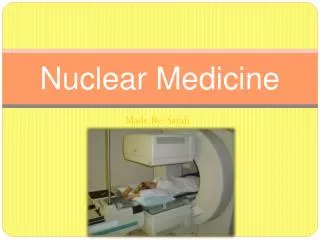
NUCLEAR MEDICINE • IMAGING SPECIALITY THAT FOCUSES ON THE USE OF RADIOACTIVE MATERIALS CALL “RADIOPHARMACEUTICALS” FOR DIAGNOSIS, THERAPY, AND MEDICAL RESEARCH.
NM • DETERMINE THE CAUSE OF A MEDICAL PROBLEM BASED ON ORGAN OR TISSUE FUNCTION. • PHYSIOLOGY
Nuclear Medicine • RADIOACTIVE MATERIAL, OR “TRACER”, IS INTRODUCED INTO THE BODY BY INJECTION, SWALLOWING, OR INHALATION. • DIFFERENT TRACERS ARE USED TO STUDY DIFFERENT PARTS OF THE BODY
TRACERS • ARE SELECTED THAT LOCALIZE IN SPECIFIC ORGANS OR TISSUES • Ex: GLUCOSE • THE AMOUNT OF RADIOACTIVE TRACER MATERIAL IS SELECTED CAREFULLY TO PROVIDE THE LOWEST AMOUNT OF RADIATION EXPOSURE
RADIOACTIVE TRACERS • PRODUCE ALPHA,GAMMA or BETA EMISSION FROM WITHIN THE ORGAN BEING STUDIED • EMISSIONS ARE TRANSFORMED INTO IMAGE THAT PROVIDE INFORMATION ABOUT THE FUNCTION OF THE ORGAN OR SYSTEM BEING STUDIED.
FUNCTION VS ANATOMY • THE EMPHASIS OF NUCLEAR MEDICINE STUDIES IS MORE ON FUNCTION AND CHEMISTRY THAN ANATOMICAL STRUCTURE
HISTORY • A FEW MONTHS AFTER “WILLIE” DISCOVERED X-RAYS • HENRI BECQUEREL DISCOVERED NATURALLY OCCURRING RADIOACTIVE SUBSTANCES. • WHAT YEAR WAS THAT?
RADIOACTIVITY • IS USED TO DESCRIBE THE RADIATION OF ENERGY IN THE FORM OF HIGH-SPEED ALPHA, GAMMA OR BETA PARTICLES OR WAVES (GAMMA RAYS), FROM THE NUCLEUS OF AN ATOM
THYROID • Was one of the first organs to be examined by Nuclear Medicine studies in the 1940s-1950s • Endocrine emphasis, initially using iodine-131 to diagnose and then treat thyroid disease.
Imaging Physics Describe the • X-ray • MRI • Ultrasound • Nuclear Medicine
ISOTOPES • ELEMENTS WITH THE SAME NUMBER OF PROTONS BUT A DIFFERENT NUMBER OF _?_ ARE REFERED TO AS ISOTOPES • THE NEUTRON-TO-PROTON RATIO IN THE NUCLEUS DETERMINS THE STABILITY OF THE ATOM
ISOTOPES • At certain ratios, atoms may be unstable, a process known as spontaneous decay can occur as the atom attempts to regain stability. • Any nuclide with an atomic number greater than 83 is radioactive
ISOTOPES • ENERGY IS RELEASED IN VARIOUS WAYS DURING THIS DECAY, OR RETURN TO GROUND STATE • RADIONUCLIDES DECAY BY THE EMISSION OF ALPHA, BETA, AND GAMMA RADIATION
HALF-LIFE • DESCRIBES THE TIME IT TAKES FOR A PARTICULAR RADIONUCLIDE TO DECAY TO ONE HALF OF ITS ORIGINAL ACTIVITY • HALF-LIVES OF MOST RADIONUCLIDES USED IN NUCLEAR MEDICINE RANGE FROM SEVERAL HOURS TO SEVERAL DAYS
NUCLEAR PHARMACY • NATURALLY OCCURRING RADIONUCLIDES HAVE VERY LONG HALF-LIVES AND DELIVER HIGH ABSORBED DOSE TO THE PATIENTS • NM RADIONUCLIDES ARE MAN MADE
TECHNETIUM • IS THE MOST COMMONLY USED RADIONUCLIDE IN NM TODAY
99MTc • EXHIBITS NEARLY IDEAL CHARACTERISTICISC FOR USE IN NM • SHORT PHYSICAL HALF-LIFE OF 6.04 HOURS • PRODUCES LOW ENERGY, GAMMA PHOTONS
RADIOPHARMACEUTICALS • ARE ADMINISTERED TO PATIENTS, THEY NEED TO BE STERILE
RADIONUCLIDE IS TAGGED TO A PHARMACEUTICAL PHARMACEUTICAL CHOOSEN BASED ON THE PARTICIPATION IN THE PHYSIOLOGIC FUNCTION OF A GIVEN ORGAN RADIOPHARMACEUTICALS
RADIOPHARMACEUTICALS • Radioactive material is obtained from a manufacturer, or from an in house generator system. • "milking" the generator - sodium chloride is passed over the molybdenum-99 column, which removes the radioactive material.
RADIATION SAFETY IN NM • RADIATION PROTECTION PRACTICES DIFFER SOMEWHAT FROM THE GENERAL SAFETY RULES • RADIONUCLIDES ARE LIQUID, SOLID, OR GASEOUS FORM. • BECAUSE OF THE NATURE OF DECAY, RADIATION EMITS AFTER INJECTION
ALARA • Dosimeters • Ring dosimeters • SPILLED CHEMICALS MUST BE CLEANED UP IMMEDIATELY
INSTRUMENTATION • RADIOACTIVE DETECTORS • GEIGER COUNTER • DOSE CALIBRATOR
NM diagnostic procedure CXR UGI series Lower GI series CT Head CT Chest CT Abdomen 4.6 mSv 0.008 mSv 4.5 mSv 6 mSv 1.5 mSv 5.4 mSv 3.9 mSV – 6.1 mSv Exposure vs Effective dose the mean effective dose:
Gamma CameraSCINTILLATION DETECTORS • Used for NM image production • GIVE OFF LIGHT IN THE PRESENCE OF IONIZING RADIATION (GAMMA RAYS) • Scintillation detectors were used in the development of the first-generation NM scanner – the rectilinear scanner, 1950
Modern-day Gamma Camera • Rectilinear scanners have evolved in complex imaging systems – gamma cameras • Still use scintillation detectors: use thalliumactivated sodium iodide crystal to detect and transform radioactive emissions into light photons. Light photons are amplified and an image is recorded
Gamma Cameras • Can be stationary or mobile • Mobile cameras can move throughout the hospital or taken to SNF facilities. • Mobile cameras have limitations of smaller field of view and quality of images
Gamma rays • What is isotropic emission • Where does isotropic emission occur when producing x-rays?
Gamma Camera • Collimator: used to separate gamma rays and keep scattered rays from entering the scintillation crystal • Resolution and sensitivity are terms used to describe the physical characteristics of collimators • Made of material with a high atomic number, lead, to absorb scattered gamma rays
Crystals • Scintillation crystals commonly used are sodium iodide with trace amounts of thallim to increase light production • Thicker crystals are better for imaging radiopharmaceuticals with higher energies, but have decreased resolution • Thinner crystals provide improved resolution but not efficient with higher kV
PMTs • Photomultiplier tubes are attached to the back of the crystals • PMTs are used to detect and convert light photons emitted from the crystal into and electronic signal that amplifies the original photon signal • The electronic signal is displayed on a cathode ray tube for filming or reading
Sodium iodide • Gamma photons interact with atoms 3 ways • Photoelectric effect • Compton scattering • Pair production
Gamma Camera Systems • Standard camera: Single detector that is moved in various positions around the PT • Dual-head camera: Allows simultaneous anterior and posterior imaging and may be used for whole-body bone or tumor imaging. • Triple-head systems may be used for brain and heart studies