Understanding the Urinary System: Functions, Structures, and Urine Formation
The urinary system plays a vital role in the elimination of waste products, such as nitrogenous wastes, toxins, and drugs, while maintaining homeostasis through water and electrolyte balance, blood pressure regulation, and red blood cell production. Key organs include the kidneys, ureters, bladder, and urethra. The nephron, the functional unit of the kidneys, is essential for urine formation, which involves processes like glomerular filtration and tubular reabsorption. This system is crucial for maintaining the body's internal environment and overall health.


Understanding the Urinary System: Functions, Structures, and Urine Formation
E N D
Presentation Transcript
Functions of the Urinary System • Elimination of waste products • Nitrogenous wastes • Toxins • Drugs • Regulate aspects of homeostasis • Water balance • Electrolytes • Acid-base balance in the blood • Blood pressure • Red blood cell production • Activation of vitamin D
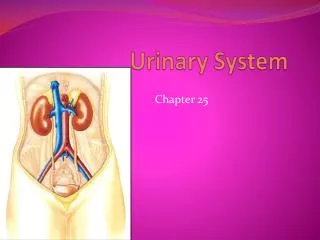
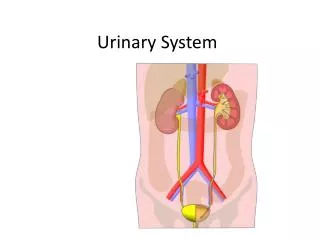
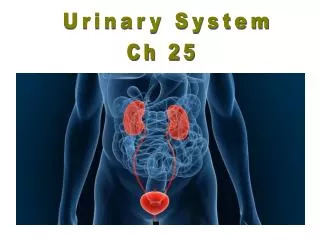
Organs of the Urinary System • Kidneys • Ureters • Urinary bladder • Urethra
Location of Kidneys • Against the dorsal body wall in a retroperitoneal position (behind the parietal peritoneum) • At the level of the T12 to L3 vertebrae • The right kidney is slightly lower than the left (due to position of the liver)
Coverings of the Kidney • Fibrous capsule • Surrounds each kidney • Perirenal fat capsule • Surrounds the kidney and cushions against blows • Renal fascia • Outermost capsule that helps hold the kidney in place against the muscles of the trunk wall
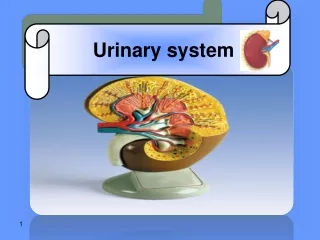
Regions of the Kidney • Renal cortex—outer region • Renal medulla—inside the cortex • Renal pelvis—inner collecting tube
Kidney Structures • Renal or medullary pyramids—triangular regions of tissue in the medulla • Renal columns—extensions of cortex-like material inward that separate the pyramids • Calyces—cup-shaped structures that funnel urine towards the renal pelvis
Blood Supply • One-quarter of the total blood supply of the body passes through the kidneys each minute • Renal artery provides each kidney with arterial blood supply
Nephron Anatomy and Physiology • The nephron is the structural and functional unitof the kidneys • Have about 1 million per kidney • Responsible for forming urine • Main structures of the nephrons • Glomerulus: Knot of capillaries; sits within a capsule called Bowman’s capsule • Renal tubule: extends from Bowman’s capsule and ends at the collecting duct
Collecting Duct • Receives urine from many nephrons • Run through the medullary pyramids • Deliver urine into the calyces and renal pelvis
Urine Formation • Glomerular filtration • Tubular reabsorption • Tubular secretion
Glomerular Filtration • Nonselective passive process • Water and solutes smaller than proteins are forced through capillary walls • Proteins and blood cells are normally too large to pass through the filtration membrane • Filtrate is collected in Bowman’s capsuleand leaves via the renal tubule
Tubular Reabsorption • The peritubular capillaries reabsorb useful substances • Water • Glucose • Amino acids • Ions • Some reabsorption is passive, most is active • Most reabsorption occurs in the proximal convoluted tubule
Tubular Reabsorption • What materials are not reabsorbed? • Nitrogenous waste products • Urea—protein breakdown • Uric acid—nucleic acid breakdown • Creatinine—associated with creatine metabolism in muscles
Tubular Secretion: Reabsorption in Reverse • Process is important for getting rid of substances not already in the filtrate • Materials left in the renal tubule move toward the ureter
Regulation of Water and Electrolyte Reabsorption • Regulation occurs primarily by hormones • Antidiuretic hormone (ADH) • Prevents excessive water loss in urine • Causes the kidney’s collecting ducts to reabsorb more water • Diabetes insipidus • Occurs when ADH is not released • Leads to huge outputs of dilute urine
Characteristics of Urine • In 24 hours, about 1.0 to 1.8 liters of urine are produced • Urine and filtrate are different • Filtrate contains everything that blood plasma does (except proteins) • Urine is what remains after the filtrate has lost most of its water, nutrients, and necessary ions through reabsorption • Urine contains nitrogenous wastes and substances that are not needed
Characteristics of Urine • Yellow color due to the pigment urochrome (from the destruction of hemoglobin) and solutes • Dilute urine is a pale, straw color • Sterile • Slightly aromatic • Normal pH of around 6
Characteristics of Urine Solutes Normally Found in Urine Solutes Normally NOT Found in Urine Glucose Blood proteins Red blood cells Hemoglobin White blood cells (pus) Bile • Sodium and potassium ions • Urea, uric acid, creatinine • Ammonia • Bicarbonate ions
Ureters • Slender tubes attaching the kidney to the bladder • Continuous with the renal pelvis • Enter the posterior aspect of the bladder • Runs behind the peritoneum • Peristalsis aids gravity in urine transport
Urinary Bladder • Smooth, collapsible, muscular sac • Temporarily stores urine • Trigone—triangular region of the bladder base • Three openings • Two from the ureters • One to the urethra • In males, the prostate gland surrounds the neck of the bladder
Urinary Bladder Wall • Three layers of smooth muscle collectively called the detrusor muscle • Mucosa made of transitional epithelium • Walls are thick and folded in an empty bladder • Bladder can expand significantly without increasing internal pressure
Urinary Bladder Capacity • A moderately full bladder is about 5 inches long and holds about 500 mL of urine • Capable of holding twice that amount of urine
Urethra • Thin-walled tube that carries urine from the bladder to the outside of the body by peristalsis • Release of urine is controlled by two sphincters • Internal urethral sphincter • Involuntary and made of smooth muscle • External urethral sphincter • Voluntary and made of skeletal muscle
Urethra Gender Differences • Length • Females is 3 to 4 cm (1 inch) • Males is 20 cm (8 inches) • Location • Females—anterior to the vaginal opening • Males—travels through the prostate and penis • Prostatic urethra • Membranous urethra • Spongy urethra • Function • Females—only carries urine • Males—carries urine and is a passageway for sperm cells and semen
Urine Elimination • After urine forms in the nephrons, the ureters (starting with the renal pelvis) carry the urine away to the bladder • Bladder is an expandable structure that stores urine before it is eliminated from the body. • Transitional epithelial cells change shape to allow for expansion and contraction.
Micturation = urination; as the bladder fills this reflex occurs though it is also under voluntary control • Urethra = tube carries urine to the outside of the body • Detrusor Muscle - attach to bladder and sphincter, control urination
Disorders of the Urinary System • Many urinary problems can be solved by drinking enough water • So how much fluid does the average, healthy adult living in a temperate climate need? The Institute of Medicine determined that an adequate intake (AI) for: • Men is roughly 3 liters (~13 cups) of total beverages a day • Women is 2.2 liters (~9 cups) of total beverages a day
Kidney Stones • Often form when urine becomes concentrated and minerals crystalize and stick together • Extracorporeal shock wave lithotripsy (ESWL) is a procedure used to shatter simple stones in the kidney or upper urinary tract. Ultrasonic waves are passed throughthe body until they strike the dense stones, and make them smaller
Cystitis • Bacteria enters the bladder or kidneys (kidney infection) • More common in women because the urethra is shorter • Commonly called a bladder infection
Urinary Tract Infection (UTI) • Frequent need to urinate • Pain in the abdomen • Burning sensation during urination • Cloudy, bad-smelling urine • Blood in the urine • Leaking urine • Low back pain • Fever and chills • Nausea and poor appetite
Overactive Bladder • Sudden contractions of the bladder produce sensation of urgency, also more common in women • Incontinence - inability to control urination (or defecation)
When Kidneys Fail… • Dialysis may be used to clean the blood(hemodialysis) • 4 hours, 3 times a week • Patients will eventually need a new kidney
Kidney Transplants • Domino Kidney Transplants or Kidney Exchanges - when you aren't a match for a family member, you can participate in a kidney exchange