Understanding Hypotheses, Models, and Experiments in Research Methodologies
130 likes | 248 Vues
This text explores the critical elements of formulating hypotheses and predictions in research. It highlights the importance of strong inference and structured abstraction through models. In addition to theoretical insights, it emphasizes different types of experiments, both laboratory and field-based, and the necessity of critical assessment when reviewing sources. The text guides researchers on assembling research proposals, from defining the problem to collecting evidence, ultimately fostering a robust understanding of the research process and methodologies.


Understanding Hypotheses, Models, and Experiments in Research Methodologies
E N D
Presentation Transcript
Gordon Chap. 5Hypotheses Predictions “Models”---maybe a conceptual flow chart Strong inference experiments
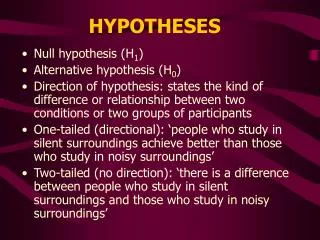
Gordon Chap. 5: Hypotheses “It is my hypothesis that…” Hypotheses Force you to: Think in terms of predictions Think of ways to disprove a claim (e.g., the null hypothesis) Makes your goals explicit Guides reviewers to core effort
Models: “structured abstractions” Quantitative models Analog models • Organize complexity • Point to questions/problems/hypotheses • Organize data and results • Present results
Experiments • Don’t think just in terms of “laboratory experiments” • Lab vs field • Quant vs. qualitative • Model experiments
“Finding Experiments” • Natural or “Found” Experiments • Weaker “control” • “natural trajectory” experiment • “natural snapshot” experiments
Booth: Chap. 5 From Problems to Sources • Need something of a plan for sources • Primary • Secondary • Tertiary • Reliability screen • Experts as sources • Bibliographical trails
What you find Avoid concluding early: • Ouy! “Nothing new to say, there goes my project!” • Question the results (answer may be “they’re pretty good!”) • Do it differently • Do it better
Chap. 6: Using Sources Read for a Problem • Stating / Clarifying the problem (look for weaknesses, chance to re-state, or challenge) Read for an Argument • Use “model” arguments from similar research---BORROW THE LOGIC! (that’s not plagiarism) Read for Evidence • Careful, complete citation • Collect “data” from your sources; • critically assess;
Re-cap • Types of research papers (review, assessment, analysis, hypothesis testing) • Modes of research: lit review, “desk top”, secondary data, primary data. • Mechanics: emulation; data; analytical approaches and tools; illustration; treatment of sources; chose and apply publishing guidelines, format and style (later); keep oral presentation in mind
Choosing a topic, preparing a proposal • Formulate a question and an argument • Start writing a short proposal • Quick literature scan; feasibility assessment • Get advice
Why Prepare a Proposal? • Forces you to commit • Required in many cases: honors thesis, grad school, books, grants • Evokes review and feedback • MOST of the elements in proposal should be in the paper! (except schedule, budget)
Research Paper Proposal • Title: test drive the paper’s title • Problem statement (1 para) • Brief lit review (may be more to show roots of the problem, test feasibility) (2-3 para) • Conceptual diagram (?; might help) • Approach/Methods (2-3 para) • Expected findings, results, and implications (maybe with alternative hypotheses) (2-3 para) • References • Schedule, budget • MOST of the elements in proposal should be in the paper! (except schedule, budget)