Ultra-Fast Optochemical Sensor for Real-Time Monitoring of Oxyhydrogen Gas Mixtures
This paper presents an innovative ultra-fast optochemical sensor designed for the rapid and accurate monitoring of oxyhydrogen gas mixtures crucial in combustion and catalysis. The sensor achieves remarkable response times of up to 10^-7 seconds with measurement rates of 0.5 to 1.0 per second, addressing the difficulties faced in measuring short-lived gas-phase radicals like H, O, and OH. Our approach minimizes spurious effects and eliminates preliminary surface preparations, making it robust for local applications in microflames and nanocatalysis. The method also allows for the analysis of catalytic properties of solid surfaces, enhancing its versatility.

Ultra-Fast Optochemical Sensor for Real-Time Monitoring of Oxyhydrogen Gas Mixtures
E N D
Presentation Transcript
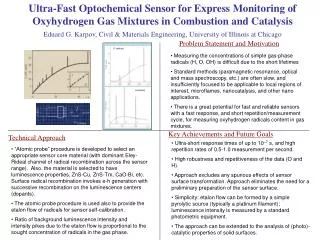
Ultra-Fast Optochemical Sensor for Express Monitoring of Oxyhydrogen Gas Mixtures in Combustion and Catalysis Eduard G. Karpov, Civil & Materials Engineering, University of Illinois at Chicago Problem Statement and Motivation O-radicals • Measuring the concentrations of simple gas-phase radicals (H, O, OH) is difficult due to the short lifetimes • Standard methods (paramagnetic resonance, optical and mass spectroscopy, etc.) are often slow, and insufficiently focused to be applicable to local regions of interest, microflames, nanocatalysis, and other nano applications. • There is a great potential for fast and reliable sensors with a fast response, and short repetition/measurement cycle, for measuring oxyhydrogen radicals content in gas mixtures. H-radicals Key Achievements and Future Goals Technical Approach • Ultra-short response times of up to 10–7 s, and high repetition rates of 0.5-1.0 measurement per second. • High robustness and repetitiveness of the data (O and H). • Approach excludes any spurious effects of sensor surface transformation. Approach eliminates the need for a preliminary preparation of the sensor surface. • Simplicity: etalon flow can be formed by a simple pyrolytic source (typically a platinum filament); luminescence intensity is measured by a standard photometric equipment. • The approach can be extended to the analysis of (photo)-catalytic properties of solid surfaces. • “Atomic probe” procedure is developed to select an appropriate sensor core material (with dominant Eley-Rideal channel of radical recombination across the sensor range). Also, the material is selected to have luminescence properties, ZnS-Cu, ZnS-Tm, CaO-Bi, etc. Surface radical recombination invokes e-h generation with successive recombination on the luminescence centers (dopants). • The atomic probe procedure is used also to provide the etalon flow of radicals for sensor self-calibration. • Ratio of background luminescence intensity and intensity pikes due to the etalon flow is proportional to the sought concentration of radicals in the gas phase.