Multilevel Coding and Iterative Multistage Decoding for Fading Channels
This presentation explores advanced techniques in multilevel coding and iterative multistage decoding for communication over fading channels. Highlighting the benefits of parallel encoding and the effectiveness of decoding strategies, including point and subset decoding, it discusses the performance of coded modulation schemes with constellation expansion. With a focus on error probability and design criteria for both slowly and rapidly fading channels, this project aims to improve coding efficiency and signal reliability, demonstrating that lower complexity multilevel codes can achieve desired performance levels.

Multilevel Coding and Iterative Multistage Decoding for Fading Channels
E N D
Presentation Transcript
Multilevel Coding and Iterative Multistage DecodingELEC 599 Project Presentation Mohammad Jaber Borran Rice University April 21, 2000
q1 K1 N x1 M-way Partitioning of data E1 (rate R1) Mapping (to 2M-point constellation) data bits from the information source q2 K2 N x2 Signal Point E2 (rate R2) qM KM N xM EM (rate RM) Multilevel Coding A number of parallel encoders The outputs at each instant select one symbol
Distance Properties • Minimum Hamming distance for encoder i: dHi , Minimum Hamming distance for symbol sequences • For TCM (because of the parallel transitions) dH = 1 • MLC is a better candidate for coded modulation on fast fading channels
Probability of error for Fading Channels • Rayleigh fading with independent fading coefficients Chernoff bound L’: effective length of the error event (Hamming distance) dk(ci,cj): distance between the kth symbols of the two sequences
Design Criterion for Fading Channels • For a fast fading channel, or a slowly fading channel with interleaving/deinterleaving Design criterion (Divsalar) • For a slowly fading channel without interleaving/deinterleaving Design criterion
Decoding Criterion • For a fast fading channel, or a slowly fading channel with interleaving/deinterleaving (akis the fading coefficient for kth symbol) • Maximizes the likelihood function
Decoding • Optimum decoder: Maximum-Likelihood decoder • If the encoder memories are n1, n2, …,nM, the total number of states is 2n, where n = n1 + n2 + … + nM. • Complexity Need to look for suboptimum decoders
If A and Y denote the transmitted and received symbol sequences respectively, using the chain rule for mutual information: • Suggests a rule for a low-complexity staged decoding procedure
Decoder D1 Decoder D2 Y Decoder DM Multistage Decoding • At stage i, decoder Di processes not only the sequence of received signal points, but also decisions of decoders Dj, for j = 1, 2, …, i-1.
... Decoder Di Y • The decoding (in stage i) is usually done in two steps • Point in subset decoding • Subset decoding • This method is not optimal in maximum likelihood sense, but it is asymptotically optimal for high SNR.
Optimal Decoding • Ai(x1,…, xi) is the subset determined by x1,…, xi • fY|A(y|a) is the transition probability (determined by the channel)
Decoder D1 Decoder D2 Y Decoder DM Rate Design Criterion then the rate of the code at level i, Ri, should satisfy
R2 I(Y;X2|X1) I(Y;X2) R1 I(Y;X1|X2) I(Y;X1) Rate Design Criterion Using the multiaccess channel analogy, if optimal decoding is used,
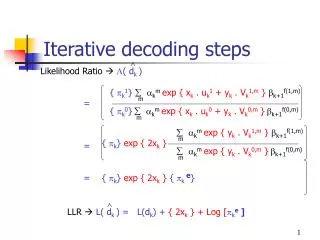
Two level Code • R1I(Y;X1|X2) • Decoder D1: Iterative Multistage Decoding Assuming then the a posteriori probabilities are This expression, then, can be used as a priori probability of point a for the second decoder.
Probability Mass Functions Error free decoding Non-zero symbol error probability
8-PSK, 2-level, 4-state, uncoded , fast Rayleigh fading channel
8-PSK, 2-level, 4-state, zero-sum, fast Rayleigh fading channel
8-PSK, 2-level, 4-state, 2-state , fast Rayleigh fading channel
Higher Constellation Expansion Ratios • For AWGN, CER is usually 2 • Further expanding Smaller MSED Reduced coding gain • For fading channels, • Further expanding Smaller product distance Reduced coding gain • Further expanding Larger Hamming distance Increased diversity gain
Conclusion • Using iterative MSD with updated a priori probabilities in the first iteration, a broader subregion of the capacity region of MLC scheme can be achieved. • Lower complexity multilevel codes can be designed to achieve the same performance. • Coded modulation schemes with constellation expansion ratio greater than two can achieve better performance for fading channels.
Coding Across Time • If channels are encoded separately, assuming • A slowly fading channel in each frequency bin, and • Independent fades for different channels (interleaving/deinterleaving across frequency bins is used)
Coding Across Frequency Bins • If coding is performed across frequency bins, assuming independent fades for different channels (interleaving/deinterleaving across frequency bins is used)