Download
1 / 6
60 likes | 197 Vues
Test your knowledge of essential literary terms with our engaging quiz! Explore key concepts like setting, protagonist, climax, theme, and more. Understand how dialogue, symbolism, and genre shape narratives. Delve into figurative language with metaphors and imagery, and discover the roles of the antagonist, narrator, and point of view in storytelling. This quiz is perfect for students, literature enthusiasts, and anyone looking to deepen their appreciation for literary works. Join us for a fun challenge and expand your literary vocabulary!

E N D
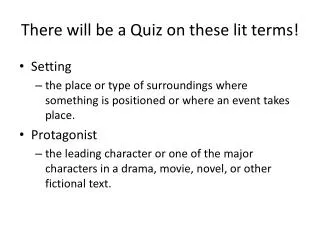
There will be a Quiz on these lit terms! • Setting • the place or type of surroundings where something is positioned or where an event takes place. • Protagonist • the leading character or one of the major characters in a drama, movie, novel, or other fictional text.
Climax • the most intense, exciting, or important point of something • Theme • the subject of a talk, a piece of writing, a person's thoughts, or an exhibition; a topic • Symbols • a thing that represents or stands for something else, esp. a material object representing something abstract.
Antagonist • a character in a story or poem who deceives, frustrates, or works against the main character, or protagonist, in some way. The antagonist doesn’t necessarily have to be a person. • Dialogue • The conversation between characters in a drama or narrative. A dialogue occurs in most works of literature.
Parable • A simple story meant to teach a moral or spiritual lesson • Allegory • a narrative that serves as an extended metaphor • A complete narrative that conveys abstract ideas
Metaphor • A type of figurative language in which a statement is made to say one thing, but is another. Metaphors can uncover new meaning about a work • Broken Heart, I feel blue, She is the apple of my eye • Imagery • visually descriptive or figurative language, esp. in a literary work • Genre • Category of artistic works (poems, fiction, non-fiction, novels, short stories, etc.)
Point-of-view • Perspective in writing (1st “I”/2nd “You”/3rd “He/She, They, Them”) • Hyperbole • An extravagant exaggeration. Used for descriptive effect. • Narrator • The voice or speaker of the story. Participant in the story (1st person). Observer in story (2nd person). Non-participant (3rd)