Understanding Earth's Atmosphere: Layers and Characteristics
70 likes | 170 Vues
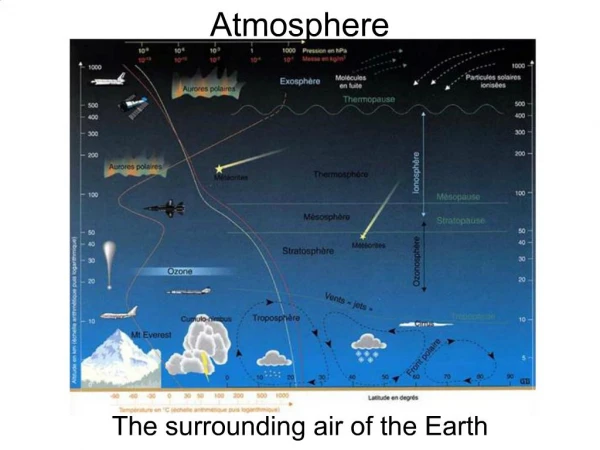
Our atmosphere is divided into distinct layers, each with unique properties and functions. The Troposphere, extending from 0-12 km, is closest to Earth's surface and is where we experience weather; temperature decreases with altitude here. Above it lies the Stratosphere, reaching up to 50 km, which contains the ozone layer. The Mesosphere (50-80 km) protects Earth from meteoroids, while temperatures drop again. Finally, the Thermosphere, extending from 80 km into space, is hot but has very thin air and includes the Ionosphere and Exosphere, where radio waves and stunning auroras occur.


Understanding Earth's Atmosphere: Layers and Characteristics
E N D
Presentation Transcript
Troposphere • Closest to Earth • Tropo means turning or changing • 0-12km • We live in this layer • Tropo means changing, and conditions change more here than in any other layer • This is where weather occurs • As altitude increases, the temperature decreases.
Troposphere continued • Contains most of the mass of the atmosphere • On average: 1 kilometer increase in altitude=6.5 degrees Celsius cooler
Stratosphere • Strato means “layer” or “spread out” • Extends from the top of the troposphere (~12 km) to about 50 km above Earth’s surface. • Upper stratosphere in warmer than lower stratosphere • Contains the ozone layer • As altitude increases, temperature increases
Mesosphere • Meso means middle • 50-80km • There is a drop in temperature from the stratosphere • Is the middle layer • Protects the Earth’s surface from being hit by most meteoroids • Temperatures can reach -90 degrees Celsius
Thermosphere -The air is very thin, but very hot!-thermo means “heat”-Extends from 80km above Earth’s surface into space-Divided into 2 layers: Ionosphere and Exosphere
Ionosphere and Exosphere Exosphere: • The outermost layer of the atmosphere • Exo means “out” Ionosphere: • Radio waves bounce off ions and go back to Earth’s surface • Brilliant light displays • Northern Hemisphere: Northern Lights