Phylum Chordata
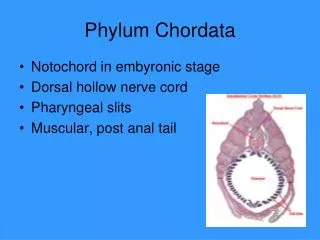
This overview provides insights into Phylum Chordata, focusing on its two subphyla: Urochordata and Cephalochordata. Key characteristics include the presence of a dorsal hollow nerve cord, notochord, gill slits, and a post-anal tail. Urochordata encompasses tunicates with notable larval stages, while the Cephalochordata showcase features such as fin rays and distinct myomeres. Detailed diagrams illustrate these anatomical structures and emphasize the evolutionary significance of these groups in understanding chordate biology.

Phylum Chordata
E N D
Presentation Transcript
Phylum Chordata
Phylum Chordata: [Fig 12.1] • Subphylum Urochordata • tunicate tadpole larvae • Note 4 chordate • characteristics: • 1. Dorsal hollow nerve cord • 2. Notochord • 3. Gill Slits • 4. Post-anal Tail (A) A
A B C D E
A B C D E Phylum Chordata: Subphylum Cephalochordata [Fig. 12.2, dorsal view] Note: dorsal fin rays (A), myomeres (B), dorsal hollow nerve cord (=nerve tube (C), notochord (D), gill slits & bars (E)
A B C B D
A B C B D Phylum Chordata: Subphylum Cephalochordata [Fig. 12.3, dorsal view] Note: fin ray (A), myomeres (B), dorsal hollow nerve cord (nerve tube) (C), notochord (D)
A B B A C C B D G B C B C E F F
A B B A C C B D G B C B C E F F Phylum Chordata: Subphylum Cephalochordata [Fig.12.3 cs- anterior region] Note: ovaries(A) gill bars(B), gill slits(C), Pharynx (D), endostyle (E), metapleural folds (F), atrium (G)
A B B C D D
A B B C D D Phylum Chordata: Subphylum Cephalochordata [Fig.12.3, cs- posterior region] Note: myomeres (A), ovaries (B), atrium (C), metapleural folds (D),