Download
1 / 14
140 likes | 247 Vues
This educational overview explores the two primary types of chemical bonds: ionic and covalent bonds. Ionic bonds form through the transfer of electrons from metals to nonmetals, resulting in positively and negatively charged ions. Examples include NaCl and Fe2O3. In contrast, covalent bonds involve the sharing of electrons between nonmetals or metalloids, creating neutral molecules like H2O and CO2. The section also includes nomenclature rules for naming binary molecular compounds through numerical prefixes and proper identification of elements.

E N D
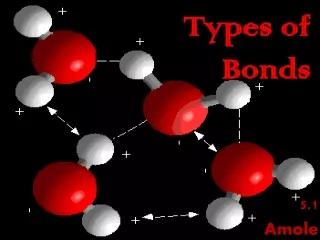
Exploring 2 Types of Bonds Science 10 Chemistry Unit
There are 2 types of bonds: • Ionic bonds • Covalent (or molecular) bonds
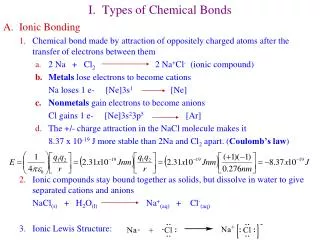
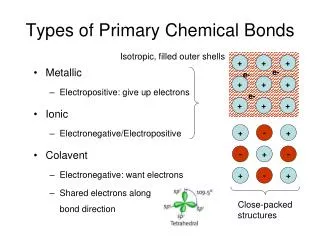
Ionic Bonds • Ionic bonds are formed when one or more electrons are transferred from one atom to another atom. • This produces positively and negatively charged particles called ions.
The forces of attraction that bind oppositely charged ions together are called ionic bonds. • Ionic bonds generally occur between metals and nonmetals (cations and anions). • Anions and cations are held together in an ionic bond due to electrostaticforces --- oppositely charged “force fields” resulting from the oppositely charged ions.
Examples: • NaCl • Fe2O3 • BaF2
Covalent Bonding: • Involves the “sharing” of electrons. • It involves the bonds formed between a non-metal and a non-metal (or metalloid).
Important: • Since these bonding non-metals (or metalloids) wish to gain electrons to become like a noble gas, and they can’t gain electrons from each other at the same time, they must share their electrons so they can both become like a noble gas. • These compounds or molecules that are formed are neutral…they have no charge.
Examples • H2O (water) • CO2 (carbon dioxide) • O2 (oxygen)
Nomenclature: • Different classes of compounds have different rules for naming. • Before naming a compound, it is important to check which class it belongs to so that you will use the appropriate set of rules.
Rules for Naming Binary Molecular Compounds • To use this set of rules, the compound must be a molecular or covalent compound. • In other words, it must be a non-metal + a non-metal (or metalloid) compound
Rules: • Name the first element as the name you see on your periodic table. • Name the second element as you see it in your “Periodic Table of Ions”…the 2nd element always ends in “-ide” • Use numerical prefixes to show how many of each atom is present in the molecule. • Mono- is frequently or often, omitted. • Write these on the “file cards”then place them in your plastic sheath.
Sulphur trioxide Dinitrogen monosulfide Naming Binary Molecular Compounds Write the names of the following covalent compounds: • SO3 _______________________________________ • N2S _______________________________________ • PH3 _______________________________________ • BF3 _______________________________________ • P2Br4 ______________________________________ • CO ________________________________________ • SiO2 _______________________________________ • SF6 _______________________________________ • NH3 _______________________________________ • NO2 ________________________________________ Phosphorous trihydride Boron trifluoride Diphosphorous tetrabromide Carbon monoxide silicon dioxide Sulphur hexafluoride Nitrogen trihydride or Ammonia nitrogen dioxide
NCl3 BC N2O3 Formula Writing of Binary Molecular Compounds • nitrogen trichloride ________________________ • boron monocarbide __________________________ • dinitrogen trioxide ________________________ • phosphorus pentafluoride __________________ • methane ______________________________ • sulfur dibromide _________________________ • diboron tetrahydride ______________________ • oxygen difluoride _________________________ • carbon disulfide __________________________ PF5 CH4 SBr2 B2H4 OF2 CS2