Phase Changes and Density
Explore the relationship between phase changes and density in different states of matter. Learn how the movement, distance, and attraction of particles change during phase transitions. Solve word problems and apply gas laws to understand the properties of gases.

Phase Changes and Density
E N D
Presentation Transcript
Phase Changes and Density • Standard: • SPS5. Obtain, evaluate, and communicate information to compare and contrast the phases of matter as they relate to atomic and molecular motion. • SPS5.a Ask questions to compare and contrast models depicting the particle arrangement and motion in solids, liquids, gases, and plasmas. • SPS5.b Plan and carry out investigations to identify the relationships among temperature, pressure, volume, and density of gases in closed systems.
Density • A physical property of matter that can be used to identify a substance is density • Densityis a unit of mass per unit of volume • Recall that mass is measured in grams or kilograms • Recall that volume is milliliters or liters for liquids and meters cubed (m3) or centimeter cubes (cm3) for solids . • Scientific Units of density: g/mL or g/cm3 or Kg/m3 Density = mass . volume d = m v
Phase Changes and Density • As most substances go from a solid to a liquid • Their energy increases • The attraction between the particle decrease • And the space between the particle increase • Since the space between the particles increase most liquids form of substances occupy a greater space (have slightly more volume) ** water is one of the few substances that does not do this. • This means the density of the object slightly decreases as the it melts.
Phase Changes and Density • As ALL substances go from a liquid to a gas • Their energy drastically increases • The attraction between the particle drastically decrease, to the point that the attraction between atoms of a gas can be ignored. • the space between the particle drastically increase • Since the space between the particles increase ALL gaseous forms of substances occupy a greater space (have considerable more volume) • This means the density of the object extremely decreases as the it vaporizes.
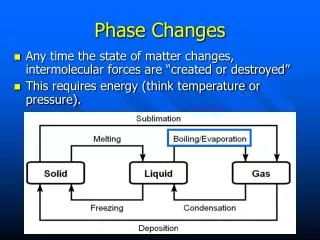
Phase Changes and Density • How does the particle movement, distance and attraction change during condensation? particles slow down distance decreases attraction increases • But what happens to density as a substance cools from a gas to form a liquid? since volume decreases the density increases
Phase Changes and Density • How does the particle movement, distance and attraction change during freezing ? particles slow down distance decreases attraction increases • But what happens to density as a substance cools from a liquid to form a solid ? since volume decreases the density increases
Phase Changes and Density • How does the particle movement, distance and attraction change during sublimation ? particles speed up distance increases attraction decreases • But what happens to density as a substance changes from a solid to form a gas ? since volume increases the density decreases
Phase Changes and Density • How does the particle movement, distance and attraction change during deposition ? particles slow down distance decreases attraction increases • But what happens to density as a substance cools from a liquid to form a solid ? since volume decreases the density increases
A block of work has a volume of 28.5 m3 and a mass of 14.05 Kg. What is it’s density?
Solving word problems • Robin measured the mass of a metal cube to be 25.48 g and the cube measures 3.0 cm on each side. What is the cube density?
The density of copper is 8.920 g/cm3 if you have 52.75cm3 sample of copper how much does it weigh? • Given: d = 8.920 g/cm3 v = 52.75cm3 m = ? • Equation: d = m/v or d(v) = m • Solve: mass = (8.920 g/cm3 )(52.75cm3 ) = mass = 470.5 g
A 250.0 g sample of lead occupied what volume? [density of lead is 11.340 g/cm3] • Given: m = 250 g d = 11.340 g/cm3 v = ? • Equation: d = m/v or v = m/d • Solve: v = 250.0 g / (11.340 g/cm3) v = 22.05 cm3
Density and Phase Changes • The density of an object is 1.429 g/L after the object changes phase the density changes to 0.999 g/L. What phase change has occurred and what is the current state of matter. • Density decreased slightly so volume increased • The object must have melted • And is now a liquid • The density of an unknown object at STP is 2.429 g/L after the object changes phase the density changes to 500.9 g/L. What phase change has occurred and what is the current state of matter. • Density increased significantly so the volume decreased considerably • The object is now a solid • And should have went form a gasto a solid so it deposit.
Applications of Gas Laws • Standard: • SPS5. Obtain, evaluate, and communicate information to compare and contrast the phases of matter as they relate to atomic and molecular motion. • SPS5.a Ask questions to compare and contrast models depicting the particle arrangement and motion in solids, liquids, gases, and plasmas. • SPS5.b Plan and carry out investigations to identify the relationships among temperature, pressure, volume, and density of gases in closed systems.
Gas Laws and Kinetic Energy • Recall that temperature is a measurement of the average kinetic energy of a substance • If temperature increases the kinetic energy increases • If temperature decrease the kinetic energy decreases • Using Gay-Lussac’s law what happens to the kinetic energy if • Recall that Gay-Lussac holds volume constant • IF Pressure is increased • Temperature must have increased • So the kinetic energy has increased • IF Pressure is decreased • Temperature must have decreased • So the kinetic energy has decreased
Gas Laws and Kinetic Energy • Using Charles’s law what happens to the kinetic energy if • -Recall that Charles holds pressure constant • IF volume is increased • Temperature must have increased • So the kinetic energy has increased • IF volume is decreased • Temperature must have decreased • So the kinetic energy has decreased • Using Bolye’s law what happens to the kinetic energy • Recall that Bolyes holds temperature constant • So there is NO change in kinetic energy
Application of Gas Laws • Using the gas laws what happens to the temperature if the pressure is doubled and volume is held constant • Volume is constant so this is Gay-Lussace’s Law • He states that pressure and temperature are DIRECTLY proportional • If pressure is doubled then temperature must have doubled • What happens to the density of the gas? • Volume is constant, mass is constant so density is constant • Using the gas laws what happens to the volume if the is temperature halved and pressure is held constant • Pressure is constant so this is Charles law • He states that volume and temperature are DIRECTLY proportional • If temperature is doubled then the volume must doubled • What happens to the density of the gas? • Volume increases, mass is constant so the density decreases
Application of Gas Laws • Using the gas laws what happens to the volume if the is pressure tripled and temperature is held constant • Temperature is constant so this is Bolye’s law • He states that volume and pressure are INVERSLEY proportional • If pressure is tripled then the volume must be 1/3 the original size • What happens to the density of the gas? • The volume decreases, mass is constant so increased