Understanding Audition: The Science of Hearing, Frequency, and Sound Localization
This chapter delves into the intricate workings of the auditory system, exploring the sense of hearing and the concepts of frequency and pitch. It examines the three sections of the ear: outer, middle, and inner ear, detailing their roles in sound transmission. Key theories such as Place Theory and Frequency Theory explain how we perceive pitch, while the chapter addresses various types of hearing loss, including conduction and sensorineural. Additionally, it discusses the relationship between amplitude and sound perception across different age groups.

Understanding Audition: The Science of Hearing, Frequency, and Sound Localization
E N D
Presentation Transcript
Chapter 5 Hearing
Audition • Audition • the sense of hearing • Frequency • the number of complete wavelengths that pass a point in a given time • Pitch • a tone’s highness or lowness • depends on frequency
Audition- The Ear • Middle Ear • chamber between eardrum and cochlea containing three tiny bones (hammer, anvil, stirrup) that concentrate the vibrations of the eardrum on the cochlea’s oval window • Inner Ear • innermost part of the ear, contining the cochlea, semicurcular canals, and vestibular sacs • Cochlea • coiled, bony, fluid-filled tube in the inner ear through which
Audition • Place Theory • the theory that links the pitch we hear with the place where the cochlea’s membrane is stimulated • Frequency Theory • the theory that the rate of nerve impulses traveling up the auditory nerve matches the frequency of a tone, thus enabling us to sense its pitch
Audition • Conduction Hearing Loss • hearing loss caused by damage to the mechanical system that conducts sound waves to the cochlea • Sensorineural Hearing Loss • hearing loss caused by damage to the cochlea’s receptor cells or to the auditory nerve • also called nerve deafness
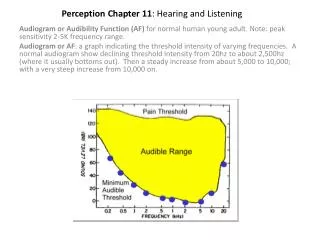
Amplitude required for perception relative to 20-29 year-old group 1 time 10 times 100 times 1000 times 32 64 128 256 512 1024 2048 4096 8192 16384 Frequency of tone in waves per second Low Pitch High Audition • Older people tend to hear low frequencies well but suffer hearing loss for high frequencies