Understanding the Urinary System: Functions, Anatomy, and Regulation
230 likes | 337 Vues
The urinary system plays a crucial role in excreting waste and regulating various body functions. This system includes key organs such as the kidneys, ureters, urinary bladder, and urethra. The kidneys, located in the retroperitoneal space, consist of the renal cortex, medulla, and pelvis, and are responsible for filtering blood and producing urine. The nephron, the functional unit, performs essential processes like glomerular filtration, tubular reabsorption, and secretion. Hormones like aldosterone and ADH regulate kidney functions, maintaining electrolyte balance and blood pressure.


Understanding the Urinary System: Functions, Anatomy, and Regulation
E N D
Presentation Transcript
Chapter 24: Urinary System
Excretion • Organs of excretion: • Kidneys • Sweat glands • Lungs • Intestines
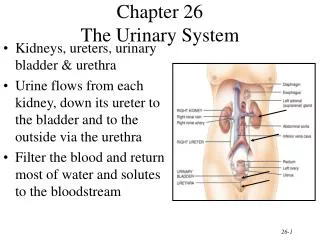
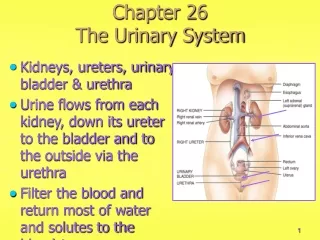
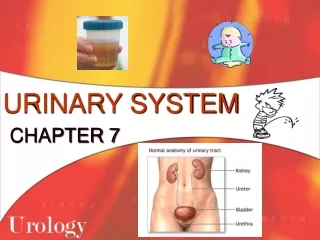
Urinary System Organs • Kidneys (2) • Ureters (2) • Urinary bladder (1) • Urethra (1)
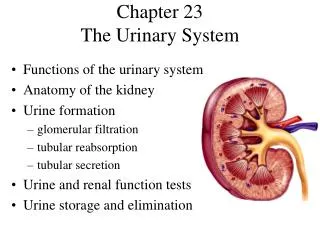
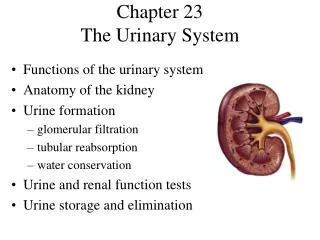
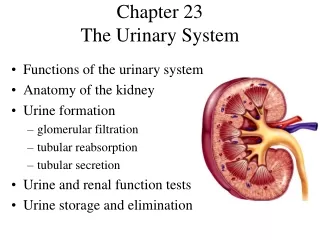
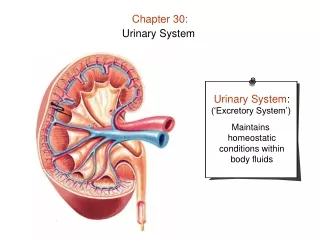
Kidneys • Location: retroperitoneal, high on the posterior wall of the abdominal cavity • Structure: reddish-brown, beanlike shape, enclosed in a tough fibrous capsule; three distinct regions: • Renal cortex • Renal medulla • Renal pelvis
Blood Supply • Blood supply: renal artery, which arises from the abdominal aorta; renal vein, which empties into the inferior vena cava
Nerve Supply • Nerve supply: renal nerves; primarily sympathetic nerves
Kidney Functions • Excrete nitrogenous waste (urea, uric aid, ammonia, and creatinine) • Regulate blood volume by determining the amount of water excreted • Help regulate the electrolyte content of the blood • Play a major role in the regulation of acid-base balance by controlling the excretion of H+ • Play a role in regulation of blood pressure • Play a role in regulation of RBC production
Urine Making: The Nephron Unit • Nephron: functional unit of the kidney; two parts: • Renal tubules: • Bowman’s capsule • proximal convoluted tubule • loop of Henle • distal convoluted tubule • collecting duct
Urine Making: The Nephron Unit The nephron unit: tubular structures.
Urine Making: The Nephron Unit 2. Renal blood vessels: • renal artery • afferent arteriole • glomerulus • efferent arteriole • peritubular capillaries • renal vein
Process of Urine Formation • Three steps: • Glomerular filtration • Tubular reabsorption • Tubular secretion
Step 1: Glomerular Filtration • Water & dissolved substances move from glomerulus into Bowman’s capsule. • caused by the blood pressure difference between glomerulus & Bowman’s capsule • Glomerular filtrate: water and dissolved substances filtered into Bowman’s capsule • Glomerular filtration rate (GFR): rate at which glomerular filtration occurs
Step 2: Tubular Reabsorption • Process by which glomerular filtrate moves from the tubules into the blood of the peritubular capillaries • Diuresis: excess secretion of urine • Diuretics: drugs that increase the production of urine
Step 3: Tubular Secretion • Process by which small amounts of substances from the peritubular capillaries move into the tubules • Secreted substances: potassium ions, hydrogen ions, uric acid, ammonium ions, and drugs
Hormones That Work on the Kidneys • Aldosterone • Antidiuretic hormone (ADH) • Natriuretic peptides • Atrial natriuretic peptide (ANP) • Brain natriuretic peptide (BNP) • Parathyroid hormone
Aldosterone • Secreted by adrenal cortex and acts primarily on the distal tubule • Stimulates the reabsorption of sodium and water and the excretion of potassium; “salt retaining” hormone • Increases blood volume and blood pressure • Released after the renin-angiotensin-aldosterone system is complete.
How Aldosterone is Released… • When B/P drops: • Renin (enzyme) is released from cells • Triggers liver to release Angiotensinogen (protein) which forms Angiotensin I (protein) • ACE changes Angiotensin I to Angiotensin II (protein) • Angiotensin II stimulates secretion of Aldosterone (hormone from adrenal cortex) • Na+ and H2O reabsorbed= BP elevates
Antidiuretic hormone (ADH) • Secreted by the posterior pituitary gland and works primarily on the collecting duct • Stimulates the reabsorption of water into blood • Plays a role in determining blood volume and blood pressure • Release is stimulated by a decrease in blood volume and an increase in the concentration of solutes in the plasma • ADH present=collecting duct becomes permeable to water=water reabsorbed into blood=concentrated urine and greater blood volume.
Natriuretic peptides • Cause natriuresis, excretion of sodium (Na+); • When released, it causes a decrease of aldosterone secretion; Na+ and water are then excreted in urine • Atrial natriuretic peptide (ANP): secreted by the walls of the atria of the heart in response to an increase in the volume of blood • Brain natriuretic peptide (BNP): secreted by the walls of the ventricles in response to elevated ventricular pressure • Opposite effect of aldosterone and ADH
Parathyroid hormone (PTH) • Secreted by the parathyroid glands • Plays an important role in the regulation of two electrolytes: calcium and phosphate • Stimulates the renal tubules to reabsorb calcium and excrete phosphate to tubules • Release stimulated by low plasma level of calcium
Characteristics of Urine • Amount (volume): average 1500 ml/24 hours • pH: average 6.0 • Specific gravity: slightly heavier than water (1.001 to 1.035) • Color: yellow (amber, straw colored, deep yellow in dehydration, pale yellow with overhydration)
Dialysis • Uremia: “urine in blood”; kidneys no longer make urine and blood is not cleansed of its waste • Dialysis: artificial method of cleansing the blood • Artificial kidney • Peritoneal dialysis
Your Plumbing • Urinary tract: • Ureters: connect the kidneys and bladder • Urinary bladder: temporary reservoir for storage of urine • Urethra: tube that carries urine from the bladder to the outside