

SlideServe
Menu
Préférences
© SlideServe · v2026

Trench Mortar

mea avatar
1 diapositives · 355 Views · Jul 27, 2014

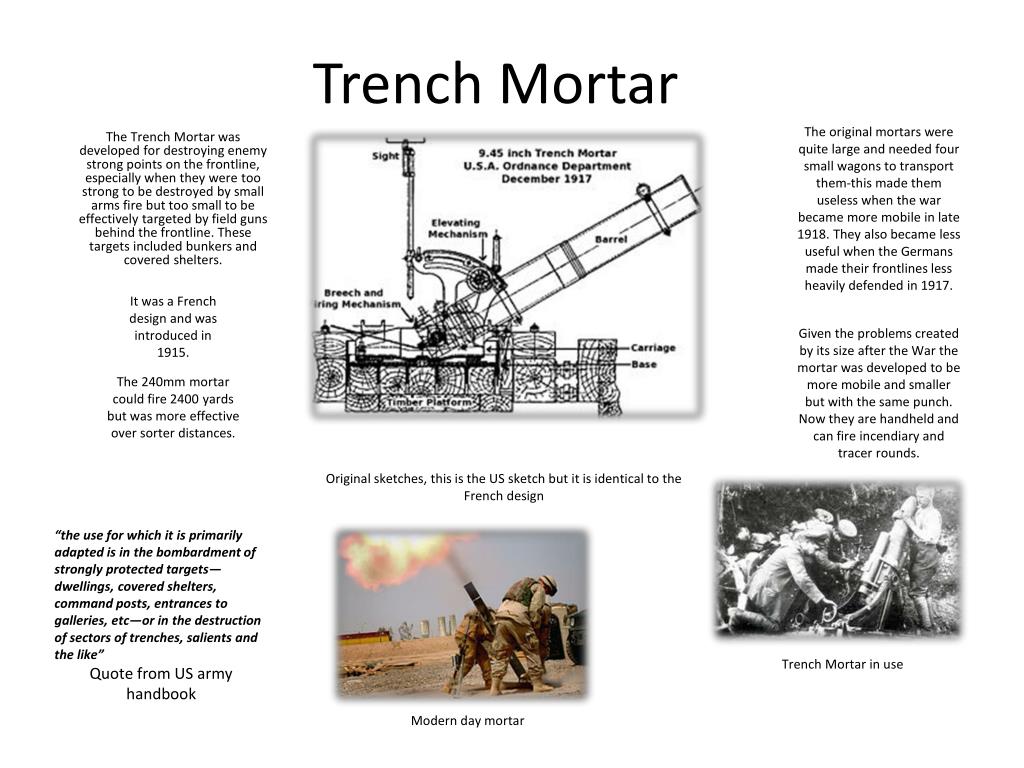
The original mortars were quite large and needed four small wagons to transport them-this made them useless when the war became more mobile in late 1918. They also became less useful when the Germans made their frontlines less heavily defended in 1917. Trench Mortar.
Trench Mortar - slide 1
01 / 1Trench Mortar
1 / 17

Télécharger la présentation

Trench Mortar
Une image / un lien ci-dessous est fourni (tel quel) pour télécharger la présentation

Politique de téléchargement : le contenu du site vous est fourni TEL QUEL pour votre information et votre usage personnel ; il ne peut être vendu, concédé sous licence ni partagé sur d’autres sites sans l’accord de son auteur.Le contenu vous est fourni TEL QUEL, pour votre information et votre usage personnel uniquement. Téléchargez la présentation en cliquant sur ce lien. Lors du téléchargement, si vous ne parvenez pas à télécharger une présentation, l’éditeur a peut-être supprimé le fichier de son serveur.Pendant le téléchargement, si vous ne parvenez pas à obtenir une présentation, le fichier a peut-être été supprimé par l’éditeur.

F I N

Plus de contenu associé

Transcription de la présentation
  1. The original mortars were quite large and needed four small wagons to transport them-this made them useless when the war became more mobile in late 1918. They also became less useful when the Germans made their frontlines less heavily defended in 1917. Trench Mortar It was a French design and was introduced in 1915. • Given the problems created by its size after the War the mortar was developed to be more mobile and smaller but with the same punch. • Now they are handheld and can fire incendiary and tracer rounds. The 240mm mortar could fire 2400 yards but was more effective over sorter distances. The Trench Mortar was developed for destroying enemy strong points on the frontline, especially when they were too strong to be destroyed by small arms fire but too small to be effectively targeted by field guns behind the frontline. These targets included bunkers and covered shelters. Original sketches, this is the US sketch but it is identical to the French design “the use for which it is primarily adapted is in the bombardment of strongly protected targets—dwellings, covered shelters, command posts, entrances to galleries, etc—or in the destruction of sectors of trenches, salients and the like” Quote from US army handbook Trench Mortar in use Modern day mortar