Understanding Experimental Phasing Methods for Crystal Structure Determination
Gain insight into experimental phasing techniques, like Patterson methods and isomorphous replacement, to solve complex molecular structures. Learn about tools, calculations, and implications of different phasing approaches.

Understanding Experimental Phasing Methods for Crystal Structure Determination
E N D
Presentation Transcript
Experimental Phasing Andrew Howard ACA Summer School 22 July 2005
Experimental Phasing • You can solve a structure with phases derived from experiments; it just may take some thinking. But the results will be statistically and esthetically satisfying.
Why don’t we always do this? • Multiple experiments • Sometimes requires specialized facilities • Requires familiarity with a different set of software • - so - • We’ll often do difference Fouriers or molecular replacement even when we do have resources to do experimental phasing
Categories of Experimental Phasing • Patterson methods • Isomorphous replacement • Single isomorphous replacement • Multiple isomorphous replacement • Anomalous diffraction • Multi-wavelength anomalous diffraction • Single-wavelenth anomalous diffraction • Optimized anomalous • ASIR / AMIR
General Concept • Remember:(r) = (1/V) h Fh exp(ih) exp(-2i h•r) • We can measure Fh • We can’t trivially measure h. • So we seek an experimental probe that will enable us to estimate h
Pattersons • Calculate the following object: • P(u) = (1/V2) h |Fh|2 cos2(h•u) • Note that h is a 3-vector in an integer-valued space, and u is a 3-vector in continuous space • This allows for analysis of interatomic vectors, so if we have n atoms, we will find n(n-1)/2 peaks in the Patterson map in u.
Can we use this to solve structures? • … sure, if n is moderate. • Doesn’t require phase information directly! Whoopie! • BUT • If n=1000, n(n-1)/2 ~ 500000. Eech. • So as a straight-ahead method for doing big molecular structures, this is a non-starter
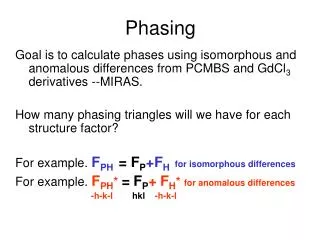
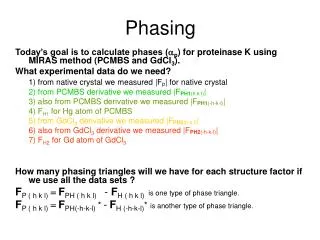
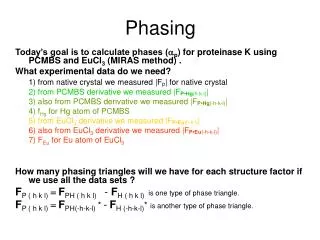
Isomorphous replacement • Relies on the fact that proteins and nucleic acids are almost entirely constructed from atoms with Z < 16, and mostly Z < 9. • Scattering power for X-rays increases rapidly with Z • Therefore if we have a small number of heavy atoms, our diffraction pattern will be significantly perturbed relative to the light-atom-only pattern
How does it work? • Measure native data • Measure data with heavy atom bound • We rely on the fact that the Fourier transform is a linear transform: • (r) = (1/V) h(Fh exp(ih)) exp(-2i h•r) • The inverse of that concept is applied to the problem we’re really trying to deal with.