Understanding the h-index: Measuring Scholarly Output and Its Implications
30 likes | 198 Vues
The h-index, proposed by J.E. Hirsch in 2005, is a metric that quantifies a researcher's scholarly output by balancing the quantity and impact of their publications. It has become a vital tool in academia, used for tenure reviews, grants, and institutional rankings. However, the h-index is not without controversy, facing challenges in calculation and author disambiguation. This ongoing debate examines its reliability, the pressure it places on researchers, and how it shapes perceptions of scholarly contributions in various disciplines.


Understanding the h-index: Measuring Scholarly Output and Its Implications
E N D
Presentation Transcript
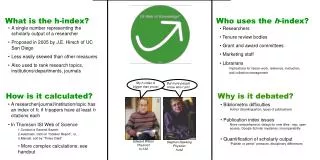
The Hirsch index of scholarly output: New measure, ongoing debate Amanda L. Werhane Kurt F. Wendt Library, UW-Madison My h-index is bigger than yours! But more people know who I am! Edward Witten Physicist h=132 Stephen Hawking Physicist h=62 What is the h-index? Who uses the h-index? • A single number representing the scholarly output of a researcher • Proposed in 2005 by J.E. Hirsch of UC San Diego • Less easily skewed than other measures • Also used to rank research topics, institutions/departments, journals • Researchers • Tenure review bodies • Grant and award committees • Marketing staff • Librarians • Implications for liaison work, reference, instruction, • and collection management How is it calculated? Why is it debated? • A researcher/journal/institution/topic has an index of h, if h papers have at least h citations each • In Thomson ISI Web of Science • Conduct a General Search • Automatic: click on “Citation Report”, or, • Manual: sort by “Times Cited” • More complex calculations: see handout • Bibliometric difficulties • Author disambiguation, types of publications • Publication index issues • None comprehensive, delays for new titles - esp. open • access, Google Scholar mysteries, incomparability • Quantification of scholarly output • “Publish or perish” pressure, disciplinary differences