Download
1 / 15
150 likes | 273 Vues
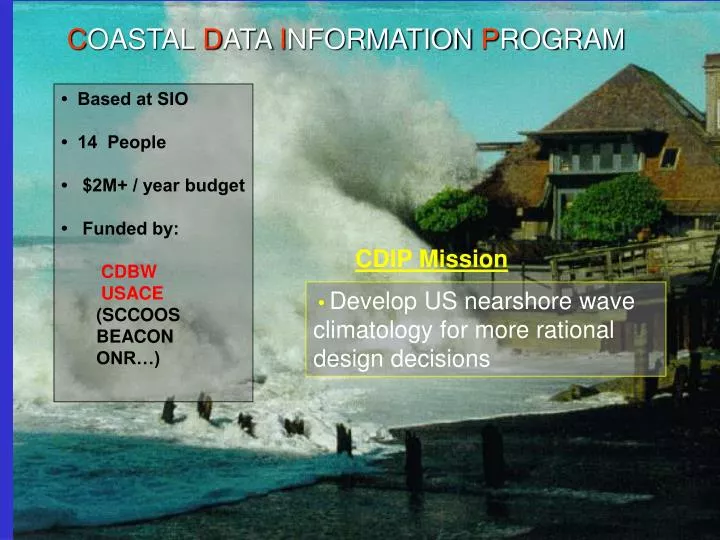
The Coastal Data Information Program (CDIP) is crucial in developing U.S. nearshore wave climatology, supporting rational design decisions. With a $2M+ annual budget and a team of 14 at Scripps Institution of Oceanography, CDIP operates 27 stations across California, Georgia, Guam, Hawaii, Oregon, and Washington. Since 1975, historical data from 150 stations has been archived for research. The program includes advanced modeling, nowcasts, forecasts, and in-situ surveys using LIDAR technology for beach process studies. Future goals involve expanding surveys and enhancing collaborations with observing systems.

E N D
COASTALDATAINFORMATIONPROGRAM • Based at SIO • 14 People • $2M+ / year budget • Funded by: CDBW USACE (SCCOOS BEACON ONR…) CDIP Mission • Develop US nearshore wave climatology for more rational design decisions
27 Operational CDIP Stations California, Georgia, Guam, Hawaii, Oregon, Washington -------------------------------------------- 150 Historical Stations (1975-present) California, Georgia, Hawaii, Minnesota, North Carolina, Oregon, Virginia, Washington, Guam ------------------------------------------- All data archived, processed and available.
MODELS NOWCASTS FORECASTS MEASUREMENTS (update @ 30 min)
Modeling Waves Across the Basin Headland shadowing Refractive effects Directional wave buoy to initiate model Island shadowing Diffraction effects Amplification over shoals
West Swell Northwest Swell
SOUTHERN CALIFORNIA BEACH PROCESSES STUDY (SCBPS) USACE Support since 2002 CDIP Wave Buoys LIDAR In-Situ ATV & JetSki Surveys: San Onofre and Torrey Pines
Insitu Surveys Monthly: Low tide above waterline (exposed beach). Twice/Year: Extend to 8m depth TorreyPines San Onofre
Optech LIDAR Instruments (Light Detection and Ranging) Altitude: 3000 ft Swath Width: 600 ft
2 Surveys/year – Long Beach to Mexican Border Spring: eroded Late Summer: accreted
Elevation Change (May – Sep 2002) San Onofre – Low seasonal Variation. Torrey Pines – High seasonal Variation.
South Swell Northwest Swell San Onofre exposed Both San Onofre and Torrey Pines are exposed to North swell. Torrey Pines sheltered by Pt. La Jolla
SCBPS Website 2002 – Present • 8 LIDAR Surveys • Monthly Surveys (Torrey Pines & San Onofre) • NCEX ------------------------------------------------------------------ FUTURE • Continue New Surveys • Ingest/display/archive other surveys (e.g. Coastal Frontiers) • Collaboration with observing systems (SCCOOS/IOOS)