Efficiently Calculating Vehicles at Fire Scenes with Recursive and Explicit Patterns
130 likes | 257 Vues
A fire incident triggers a sequence of vehicles: starting with 3 fire engines, followed by 4 police cars, 4 ambulances, and 4 news trucks in a recursive manner. To manage a situation with potentially 115 different types of vehicles responding, we introduce explicit pattern rules for efficient calculations. Using a t-table and formulas, we can determine the total number of vehicles without laboriously counting each step. This method simplifies finding totals even with complex patterns, illustrating how explicit rules can save time in problem-solving.


Efficiently Calculating Vehicles at Fire Scenes with Recursive and Explicit Patterns
E N D
Presentation Transcript
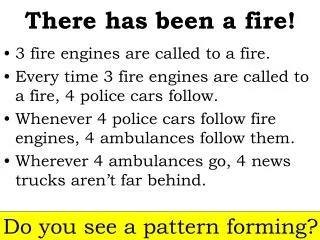
There has been a fire! • 3 fire engines are called to a fire. • Every time 3 fire engines are called to a fire, 4 police cars follow. • Whenever 4 police cars follow fire engines, 4 ambulances follow them. • Wherever 4 ambulances go, 4 news trucks aren’t far behind. Do you see a pattern forming?
#2 #3 #4 #1
We can use a recursive pattern rule to show how our pattern begins and continues: Start with 3 vehicles and add 4 each time. 3, 7, 11, 15
Imagine now that 4 racecars followed the news vans. Then 4 jeeps followed the racecars.
We could still use our recursive pattern rule to determine the number of total vehicles. , 11 , 15 , 19 , 23 3 , 7
But what if every other car in town followed to see what all the commotion was about?—4 Chevy trucks, then 4 Honda Accords, then 4 Dodge Neons, then 4 Nissan Sentras…. And this continued until 115 different types of vehicles had arrived at the fire, right from the 3 fire trucks we started with!
Well, then we would need a more efficient method to find the total number of vehicles at the fire because using our recursive pattern rule would take way too long. There would be too many numbers!
We need something called an explicit pattern rule--a patterning shortcut that tells us the exact steps we need to take in order to extend a pattern. An explicit pattern rule can save us time, especially when we’re trying to find out the number of total vehicles at a fire when 115 different types of vehicles follow each other.
An explicit pattern rule can take two different forms. The first method (I’ll call the “Solve the Riddle Method”) uses a t-table. On the left side of the t-table is the number of different kinds of vehicles, and on the right side is the total number of vehicles. All we do in this method is try to find a way to relate the first column to the second column and make a rule from it. Let’s figure out a rule and use it for the 115th term.
# of Types of Vehicles(Term #) # of Total Vehicles(Term) X 4 - 1 1 2 3 4 3 7 11 15 115 459
Was that tricky? It takes practice, but it can be fun! The other method requires less thought. As long as you can remember the steps, it should be a piece of cake, and, better yet, it should work every time you use it! Follow the formula on the next slide.
We want to find out how many total vehicles are at the fire when 115 different kinds of vehicles are there. We subtract 1 from 115 because the pattern is increasing 114 times. We don’t want to double count our starting point. 3 + (115 – 1) X 4 3 is the number we started our pattern with. 4 is the common difference in this pattern, which means we increased our pattern by 4 with every term.
3 + (115 – 1) X 4 = 3 + 114 X 4 = 3 + 456 = 459