The Gold Foil Experiment and The New Model of the Atom
In 1909, Geiger and Marsden under Rutherford's direction conducted the Gold Foil Experiment dismantling Thomson's model. Alpha particles on gold foil led to Rutherford's breakthrough atomic model. Discover the pivotal experiment that revolutionized atomic theory.

The Gold Foil Experiment and The New Model of the Atom
E N D
Presentation Transcript
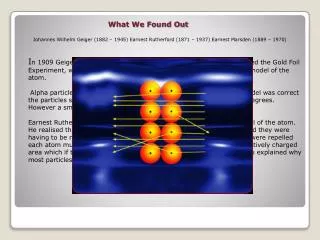
Johannes Wilhelm Geiger (1882 – 1945) Earnest Rutherford (1871 – 1937) Earnest Marsden (1889 – 1970) In 1909 Geiger and Marsden under the direction of Rutherford conducted the Gold Foil Experiment, which led to the downfall of J.J. Thomson’s plum pudding model of the atom. Alpha particles were fired a very thin gold foil. If the plum pudding model was correct the particles should have been deflected by no more than a couple of degrees. However a small % were deflected by angles greater than 90 degrees. Earnest Rutherford studied these results and came up with a new model of the atom. He realised that for the positively charged alpha particles to be deflected they were having to be repelled by a something else positive. As only a small % were repelled each atom must contain a small (in ratio with the size of the atom) positively charged area which if the particles came close enough to, were repelled by. This explained why most particles went straight through. What We Found Out