DEMAND
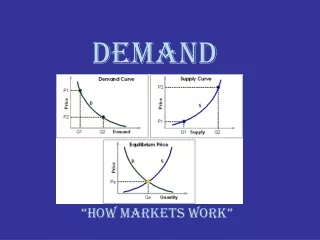
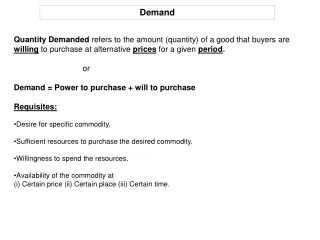
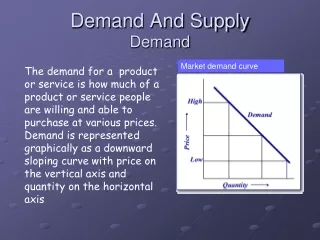
DEMAND. Demand. Demand is the desire to have some good or service and the ability to pay for it. The law of demand states that when the PRICE of a good or service GOES DOWN, consumers buy MORE, meaning demand increases. If price goes UP, demand should DECREASE.


DEMAND
E N D
Presentation Transcript
Demand • Demand is the desire to have some good or service and the ability to pay for it. • The law of demand states that when the PRICE of a good or service GOES DOWN, consumers buy MORE, meaning demand increases. • If price goes UP, demand should DECREASE. The Big Bang Theory 5x05 - The Sword - YouTube
Demand Curve Price A 30 B 25 DEMAND CURVE C 20 D 15 E 10 F 5 0 1 4 5 2 3 Quantity
Other Terms • Due to the law of diminishing marginal utility, people will only buy additional goods at a given time if price declines.
Other Terms • The Income Effect – the change in the amount a consumer will buy because their purchasing power of their income changes. • The Substitution Effect – a change in the amount that consumers will buy because they will buy substitute goods instead.
Changes in Demand • Change in Quantity Demanded is an INCREASE or DECREASE in the amount demanded because of a change in PRICE. • Change in Demand is when something prompts consumers to buy DIFFFERENT AMOUNTS of a good at every price. My Life as a Mighty Mito Mamma: Crashes and Supply and Demand
Change in Quantity Demand A B Price C D Moves along the curve E F Quantity
Change in Demand A A B B Price C C D D Shifts left or right E E F F Quantity
Terms • Individual Demand Curve – the demand for an individual in a specific market. • Market Demand Curve – the total demands of all individuals in a given market.These numbers should be bigger.
Terms • Normal Goods – goods consumers demand more of when their income rises. • Inferior Goods – goods that consumers demand more of when their income falls.
Demand Changes • Change in quantity demanded is a change in PRICE or QUANTIY. This will cause you to move along the curve, up/down. • Change in demand meanwhile is a change in the AMOUNT YOU BUY. This means the curve will shift to the left or to the right. There are six factors that influence this.
Complements • Complements are goods that are used together, so that a rise in demand in one good will increase the demand for the other good. • If a price change occurs for the complement, it will affect the demand for the original item.
Substitutes • Substitutes are goods/services that can be used in place of another good or service. • If the price of a substitute changes, people may be more/less inclined to get the original item. • Examples • Pepsi or Coca Cola • Ordering Pizza or Chinese for dinner
Consumer Expectations • If people believe that the price of a good or service will change in the future, that may impact their decision to buy then or now. • Examples • Cars • Gas • Tickle-Me-Elmo
Consumer Tastes • People’s tastes change overtime! • When goods are more popular, people demand more of it. • When goods loose popularity, people have less demand for it. • Advertising influences people’s tastes. http://www.youtube.com/watch?v=R55e-uHQna0
Market Size • The size of the market is based on the number of consumers. • If people leave a region, the market size will decrease meaning the curve will shift to the left and vice versa. • Example • People leaving Buffalo has caused a smaller market size. • More people moving to Florida and Texas has created larger market sizes in these states.
Income • People’s ability to buy certain goods is affected by their income. • If their income changes, then their ability to buy certain goods will change. • Less money means the curve will shift left, more money will shift the curve to the right. • More money you can buy _________ goods. • Less money you will buy __________ goods. NORMAL INFERIOR
Elasticity of Demand • Elasticity of demand is how responsive consumers are to price changes. • Elastic demand – quantity demanded will change greatly as price changes. • Inelastic demand – quantity demanded will change little as price changes.
Elastic Demand Price When demand is elastic, prices will not change much, but quantity demanded will change. 30 25 DEMAND CURVE A 20 B C 15 D E F 10 5 0 1 4 5 2 3 Quantity
Inelastic Demand Price A When demand is in elastic, prices will change a lot, but quantity demanded will not change much. 30 B 25 DEMAND CURVE C 20 D 15 E 10 F 5 0 10 40 50 20 30 Quantity
Factors of Elasticity Factors of elasticity are… 1. Substitutes of Goods or Services • Goods/services with few/no substitutes are inelastic as you have to pay regardless to get that item. • The more substitutes, the more elastic demand is. 2. Proportion of Income 3. Necessity or Luxury • Needs are inelastic; you’ll typically pay higher prices to satisfy these, but luxuries are elastic.