Download
1 / 19
190 likes | 316 Vues
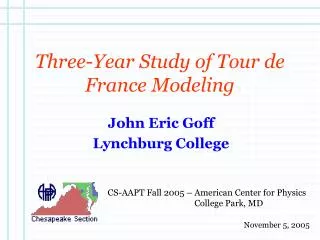
This study presents a comprehensive modeling of the Tour de France over three years, focusing on the physics of cycling performance. Beginning as a project derived from a computational physics course, it evolved into the detailed modeling of the 2003, 2004, and 2005 races. Utilizing data on bike-rider dynamics, forces acting on cyclists, and environmental factors such as wind, the research dissects the intricacies of cycling mechanics. This paper contributes not only to educational discourse in physics but also offers insights into professional cycling performance.

E N D
Three-Year Study of Tour de France Modeling John Eric Goff Lynchburg College CS-AAPT Fall 2005 – American Center for Physics College Park, MD November 5, 2005
History of Research • Ben Hannas (LC ’03) – Computational Physics Course Project (Spring ’03) • Ideas from Giordano’s Computational Physics • Ben Modeled Two Stages of 2001 Tour de France for Project • After May ’03 Graduation, Ben and I Modeled Entire 2003 Tour de France • American Journal of Physics (May 2004) • Ben and I Modeled Entire 2004 Tour de France • European Journal of Physics (February 2005) • Contacted by Richmond Times-Dispatch and Asked to Model 2005 Tour de France
Ben’s Seminal Idea • Get stage profiles from www.letour.fr . • Convert each profile into a series of inclined planes. Stage 16 of 2005 Tour de France
Forces on Bike-Rider Combo • Weight: W = mg • Normal Force: FN = mg cosθ • Biker’s Force: Fb = Pb/v • Retarding Forces: FR = FD + Fr FD = CDAv2/2 (Drag Force) Fr = μrFN (Rolling Friction)
Parameters • Bike-Rider Mass: m = 77 kg • Coefficient of Rolling Friction: μr = 0.003 • Air Density: = 1.2 kg/m3 • Drag Coefficient ● Cross-Sectional Area: CDA = 0.35 m2 (θ ≥ 0, uphill) CDA = 0.25 m2 (θ < 0, downhill)
Biker’s Power Output • 2003 Tour de France
Biker’s Power Output • 2004 Tour de France
Other Changes for 2004 • Short Stages – 0, 4, 16, and 19 • Reduce CDA by 20% for Drafting and Sleek Clothing (except stage 16)
Biker’s Power Output • 2005 Tour de France (Not much change!)
On to 2005’s Tour de France We are too slow!!!
What Happened?!? • Tailwinds permeated the first week of the race. • Wind speeds measured in the 10-20 mph (16-32 km/hr) range. • Easy way to account for tailwind – increase power input. • How much???
Add Power from Tailwind • Terminal speed reached when forward force matches sum of retarding forces. • Tailwind means biker’s speed relative to air goes down. • Only considering the dominate air drag: Pb~ vt3 • Add about 50W to main 325W power.
Lance Armstrong • 7th Straight Tour de France Win! • Winning Time: 86h 15’ 02” • 3593-Kilometer Race: vave ≈ 11.6 m/s ≈ 41.7 km/hr ≈ 25.9 mph vmax ≈ 15.9 m/s ≈ 57.2 km/hr ≈ 35.5 mph (average for stage 4)
Other Tour Races in 2004(Use 2004 Model) Thanks Brett Taylor at Radford University!