
Skeletal System
E N D
Presentation Transcript
Skeletal System http://www.youtube.com/watch?v=sRI3MxWJ7tY http://www.abcya.com/skeletal_system.htm
Skeletal System Objective: By the end of the lesson students will be able to list (3) bones in the body, as well as explain (2) functions of the skeletal system.
Fun Questions • How many bones are in the human body? • What is the largest bone in your body?
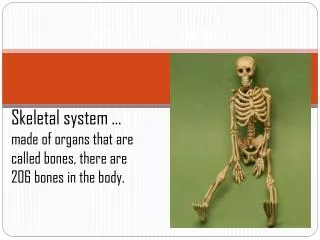
Key Point: The skeletal system consists of 206 bones and connective tissue!
Have You Ever?? • Broken a bone?? 1 minute share with the person sitting behind/in front of you! Who is he? What’s his story?
5 Main Functions • 1. Provides support for the body • 2. Protects internal organs from damage. • 3. Acts as framework for attached muscles. • 4. Production of red and white blood cells • 5. Allows movement of limbs
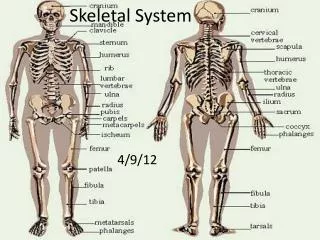
2 main parts of skeletal system • 1. Axial • Center of skeleton • Ribs, sternum, skull, and spine • 2. Appendicular • All the limbs outside the axial skeleton
Bone Types • LONG–primarily used to support weight. • Examples legs, arms, fingers (phalanges)
Bone Types • SHORT – support weight and allow small movements. • Examples ankles and wrists
Bone Types • FLAT – for protection and support. • Examples ribs, shoulder blades (SCAPULA), breastbone (STERNUM)
Bone Types • IRREGULAR BONES – protection of nervous tissue • ExamplesVertebrae (backbone) protect spinal cord, mandible (jaw), sacrum
Anatomy of a Long Bone • 1. Diaphysis – Shaft of bone • 2. Epiphysis – ends of the bone
2 Layers of Bone • 1. Periosteum – Outer layer • Dense, thick, and hard • 2. Endosteum – Inner layer • Less dense bone that is sponge like.
Defined: Points at which bones meet Joints http://www.youtube.com/watch?v=zCCD52Pty4A http://www.sportmed.mb.ca/uploads/pdfs/What%20we%20knew%20-%20What%20we%20know.pdf statistics Slightly moveable – vertebra and ribs
Types of Joints • 1. Joint – a location in the body where two or more bones meet to enable movement. • 2. Ball and Socket Joint • Enables wide range of motion • Example – shoulder and hip • 3. Hinge Joint • Lesser range of motion than ball and socket • Example elbow and knee • 4. Pivot Joint • Enables rotation of head and forearm
Connective Tissue There are 3 types of connective tissue: Cartilage – strong, flexible cushion between the bones (knees, hips, etc.)
Connective Tissue • Ligaments – attach bone to bone http://www.youtube.com/watch?v=kNvtEMTF6YE
3 Types of Connective Tissue • 3. Tendon – fibrous cord that attaches MUSCLE to BONE! • Achilles tendon in back of your foot http://bleacherreport.com/articles/1729646-a-closer-look-at-the-acl-as-tears-continue-to-run-rampant-in-the-nfl
Problems of Skeletal System • Fracture – any type of break in the bone • 1. Hairline Fracture – parts of the bone do not separate
Problems of Skeletal System • 2. Transverse Fracture – when the break is completely across the bone
Problems of Skeletal System • 3. Comminuted Fracture – bone shatters in more than 2 pieces
Problems of Skeletal System • 4. Osteoporosis – condition in which there is a progressive loss of bone tissue • Bones weaken and become brittle • Caused by a lack of vitamin D and calcium • Milk and other dairy products are excellent sources. • Weight training and physical activity help increase bone mass
Osteoporosis • http://www.youtube.com/watch?v=NKVKNqIOnh0&feature=related • http://www.youtube.com/watch?v=rHyeZhcoZcQ&feature=related
Problems of Skeletal System • 5. Scoliosis • Lateral, side to side, curvature of the spine. • Depending on how serious, can be treated by light exercise, a special brace, or surgery.
Problems of the Joints • 1. Dislocation – bone slips out of place, tearing the ligaments that attach bone to bone
Problems of the Joints • 2. Arthritis – inflammation of a joint, resulting from natural wear and tear
Problems of the Joints • 3. Carpal tunnel syndrome – ligaments and tendons in the wrist swell, causing numbness, pain, and weakness in the hand. • Caused by normal wear and tear – typing, writing, etc.
Ways To Care For Your Skeletal System: Have a healthy diet DAIRY 2. Wear protective gear
Ways To Care For Your Skeletal System: 3. Get regular check-ups 4. Do weight bearing exercises
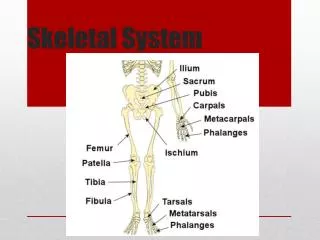
Pelvis Vertebrae Label each bone Color each bone Place each bone in correct location Be neat