
Statistical Experiments
E N D
Presentation Transcript
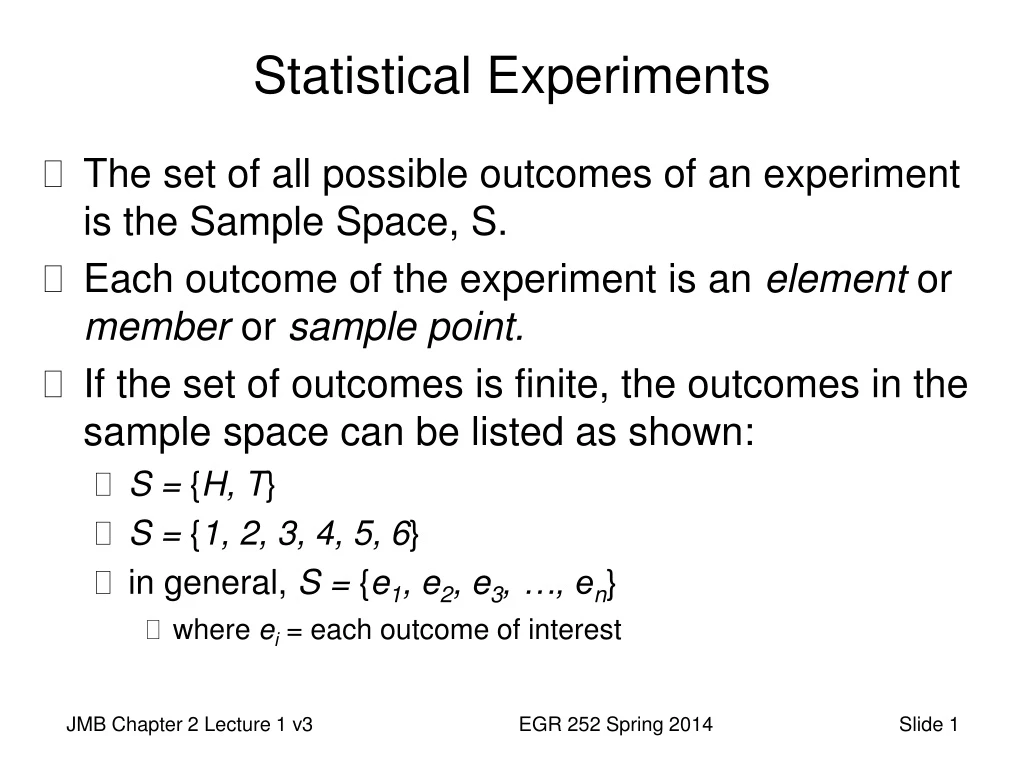
Statistical Experiments • The set of all possible outcomes of an experiment is the Sample Space, S. • Each outcome of the experiment is an element or member or sample point. • If the set of outcomes is finite, the outcomes in the sample space can be listed as shown: • S = {H, T} • S = {1, 2, 3, 4, 5, 6} • in general, S = {e1, e2, e3, …, en} • where ei = each outcome of interest EGR 252 Spring 2014
Tree Diagram • If the set of outcomes is finite sometimes a tree diagram is helpful in determining the elements in the sample space. • The tree diagram for students enrolled in the School of Engineering by gender and degree: • The sample space: S = {MEGR, MIDM, MTCO, FEGR, FIDM, FTCO} EGR 252 Spring 2014
Your Turn: Sample Space • Your turn: The sample space of gender and specialization of all BSE students in the School of Engineering is … or • 2 genders, 6 specializations, • 12 outcomes in the entire sample space S = {FECE, MECE, FEVE, MEVE, FISE, MISE, FMAE, etc} S = {BMEF, BMEM, CPEF, CPEM, ECEF, ECEM, ISEF, ISEM… } EGR 252 Spring 2014
Definition of an Event • A subset of the sample space reflecting the specific occurrences of interest. • Example: In the sample space of gender and specialization of all BSE students in the School of Engineering, the event F could be “the student is female” • F = {BMEF, CPEF, ECEF, EVEF, ISEF, MAEF} EGR 252 Spring 2014
Operations on Events • Complement of an event, (A’, if A is the event) • If event F is students who are female, F’ = {BMEM, EVEM, CPEM, ECEM, ISEM, MAEM} • Intersection of two events, (A ∩ B) • If E = environmental engineering students and F = female students, (E ∩ F) = {EVEF} • Union of two events, (A U B) • If E =environmental engineering students and I = industrial engineering students, (E U I) = {EVEF, EVEM, ISEF, ISEM} EGR 252 Spring 2014
Venn Diagrams • Mutually exclusive or disjoint events Male Female • Intersection of two events Let Event E be EVE students (green circle) Let Event F be female students (red circle) E ∩ F is the overlap – brown area EGR 252 Spring 2014
Other Venn Diagram Examples • Five non-mutually exclusive events • Subset – The green circle is a subset of the beige circle EGR 252 Spring 2014
Subset Examples • Students who are male • Students who are on the ME track in ECE • Female students who are required to take ISE 428 to graduate • Female students in this room who are wearing jeans • Printers in the engineering building that are available for student use EGR 252 Spring 2014
Let’s Try It A U C = ? B’∩ A = ? A ∩ B ∩ C = ? (A U B) ∩ C’ = ? B A 2 6 7 1 4 3 5 C EGR 252 Fall 2015
Sample Points • Multiplication Rule • If event A can occur n1ways and event B can occur n2ways, then an event C that includes both A and B can occur n1 * n2ways. • Example, if there are 6 different female students and 6 different male students in the room, then there are 6 * 6 = 36 ways to choose a team consisting of a female and a male student . EGR 252 Spring 2014
Permutations • Definition: an arrangement of all or part of a set of objects. • The total number of permutations of the 6 engineering specializations in MUSE is … 6*5*4*3*2*1 = 720 • In general, the number of permutations of n objects is n! NOTE: 1! = 1 and 0! = 1 EGR 252 Spring 2014
Permutation Subsets • In general, where n = the total number of distinct items and r = the number of items in the subset • Given that there are 6 specializations, if we take the number of specializations 3 at a time (n = 6, r = 3), the number of permutations is EGR 252 Spring 2014
Permutation Example • Mercer is introducing a new scholarship competition program for computer engineers interested in Big Data analysis. First, second, and third place winners will receive a specified scholarship amount. If 12 students applied for the scholarship, how many ways can the winners be selected? • If the outcome is defined as ‘first place student, second place student, and third place student • Total number of outcomes is 12P3 = 12!/(12-3)! = 1320 • Order matters EGR 252 Spring 2014
Combinations • Selections of subsets without regard to order. • Example: How many ways can we select 3 winners (w/out regard to placing) from the 12 students? • Total number of outcomes is 12C3 = 12! / [3!(12-3)!] = 220 EGR 252 Spring 2014
Let’s Try It • Registrants at a large convention are offered 6 sightseeing tours on each of 3 days. In how many ways can a person arrange to go on a sightseeing tour planned by this convention? Multiplication Rule: On each of 3 days, you have a choice of 6 tours. Event A: The particular day, can occur 3 ways Event B: The specific tour, can occur 6 ways n1 * n2 = 18 ways EGR 252 Fall 2015
Let’s Try It • Find the number of ways that 7 faculty members can be assigned to 4 sections of EGR 252 if no faculty member is assigned to more than one section. Permutation: Order matters 7 faculty members selected 4 at a time: EGR 252 Fall 2015
Introduction to Probability • The probability of an event, A is the likelihood of that event given the entire sample space of possible events. • P(A) = target outcome / all possible outcomes • 0 ≤ P(A) ≤ 1 P(ø) = 0 P(S) = 1 • For mutually exclusive events, P(A1U A2U … U Ak) = P(A1) + P(A2) + … P(Ak) EGR 252 Spring 2014
Calculating Probabilities • Examples: • There are 26 students enrolled in a section of EGR 252, 3 of whom are BME students. The probability of selecting a BME student at random off of the class roll is: P(BME) = 3/26 = 0.1154 2. The probability of drawing 1 heart from a standard 52-card deck is: P(heart) = 13/52 = 1/4 EGR 252 Spring 2014
Additive Rules Experiment: Draw one card at random from a standard 52 card deck. What is the probability that the card is a heart or a diamond? Note that hearts and diamonds are mutually exclusive. Your turn: What is the probability that the card drawn at random is a heart or a face card (J,Q,K)? EGR 252 Spring 2014
Your Turn: Solution Experiment: Draw one card at random from a standard 52 card deck. What is the probability that the card drawn at random is a heart or a face card (J,Q,K)? Note that hearts and face cards are not mutually exclusive. P(H U F) = P(H) + P(F) – P(H∩F) = 13/52 + 12/52 – 3/52 = 22/52 EGR 252 Spring 2014
Card-Playing Probability Example • P(A) = target outcome / all possible outcomes • If an experiment can result in any of N different equally likely outcomes, and if exactly n of those outcomes correspond to event A, then the probability Event A is P(A) EGR 252 Spring 2014
Card Playing Probability Example • In a poker hand consisting of 5 cards, find the probability of holding 2 aces and 3 jacks. Combination…order does not matter. The number of ways of being dealt 2 aces from 4 cards is combinations(2 aces) = → The number of ways of being dealt 3 jacks from 4 cards is combinations(3 jacks) = → Per the multiplication rule, there are n = 6*4 = 24 possible hands with 2 aces and 3 jacks given the number of aces and jacks available in a 52 card deck. EGR 252 Fall 2015
Card Playing Probability Example Con’t The total number of 5-card poker hands are equally likely therefore N = Likely Outcomes (N) = → Per rule 2.3: P(A) = The probability of getting 2 aces and 3 jacks in a 5-card poker hand is 0.9 X 10⁻⁵ EGR 252 Fall 2015
Your Turn • A box contains 500 envelopes, of which 75 contain $100 in cash, 150 contain $25, and 275 contain $10. An envelop may be purchased for $25. • (a) What is the sample space for the different amounts of money? • (b) Assign probabilities to the sample points • (c) Find the probability that the first envelop purchased will contain less than $100. EGR 252 Fall 2015
Your Turn: Solution • (a) S = {$10, $25, $100} • (b) P($10) = 0.55, P($25) 0.3, P($100) = 0.15 • (c) P($10) + P($25) = 0.55 + 0.3 = 0.85 or, 1 – P($100) = 1 – 0.15 = 0.85 EGR 252 Fall 2015
Homework Reading • Read section 2.6 and Chapter 3 of your textbook EGR 252 Fall 2015