Understanding Planet Sizes, Distances, and the Formation of the Solar System
Explore the intriguing characteristics of planets within our solar system, including their sizes, distances from the Sun, and distinct classifications as terrestrial or gas giants. Learn about the gravitational forces at play and how they shape planetary orbits. The inner solar system features smaller, closely spaced rocky planets, while the outer system is dominated by larger gas giants. Discover the processes that formed these planets and their atmospheres, along with the impact of asteroids and comets, aiding our understanding of their development within a vast disk of gas and dust.

Understanding Planet Sizes, Distances, and the Formation of the Solar System
E N D
Presentation Transcript
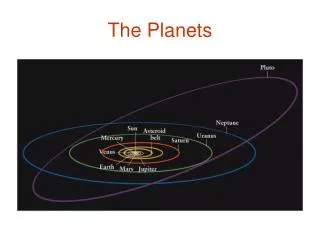
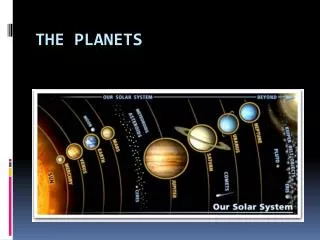
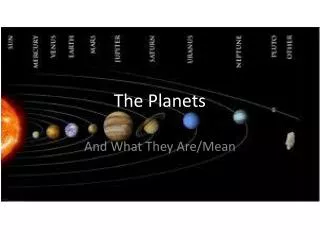
Sizes and Distances • Planets can be seen because they reflect sunlight – they do not give off visible light of their own • Astronomical Unit (AU) – Earth’s average distance from the Sun • The planets are spaced unevenly
Sizes and Distances • Inner Solar System – planets that are smaller, relatively close together and close to the Sun (Mercury, Venus, Earth, Mars)
Sizes and Distances • Outer Solar System – planets are larger, farther from the Sun, and much more spread out (Jupiter, Saturn, Uranus, Neptune)
Orbits • More than 99% of all the mass in the solar system is in the Sun • The gravitational pull of this huge mass causes planets and most other objects in the solar system to move around, or orbit, the Sun • Ellipse – the shape of each orbit – a flattened circle or oval
Formation of the Solar System • The planets orbit the Sun in similar ways – their paths are almost in a flatplane • The planets and other objects orbit the Sun in the same counterclockwise direction, giving scientists clues about how the solar system formed
Formation of the Solar System • The solar system formed out of a huge cloud of different gases and specks of dust, which flattened out into a disk of whirling material - most of the mass fell to the center and became a star, the Sun
Formation of the Solar System • Large Round Objects • When an object has enough mass, gravity pulls each part together in towards the center to make the object round • The planets formed when tiny bits of dust and frozen gases in the disk stuck together in clumps and the clumps continued to stick together
Formation of the Solar System • Small Lumpy Objects • Small rocky clumps close to the Sun are called asteroids • Small icy clumps farther from the Sun are called comets
The Terrestrial Planets • Terrestrial Planets – the four planets closest to the Sun (Mercury, Venus, Earth, Mars) • All terrestrial planets have layers – rocky crusts and dense mantles and cores • Atmospheres on terrestrial planets mainly formed from gases that poured out of volcanoes
The Terrestrial Planets • Four types of processes then shaped each planet’s rocky crust • Tectonics– the processes of change in a crust due to the motion of hot material underneath • Volcanism– when molten rock moves from a planet’s hot interior onto its surface
The Terrestrial Planets • Weathering and Erosion - weather or small impacts break down rocks and the broken material is moved by a group of processes called erosion • Impact Craters - a small object sometimes hits a planet’s surface so fast that it causes an explosion – the resulting impact crater is often ten times larger than the object that produced it
The Gas Giants • Gas Giants – are made mainly of hydrogen, helium, and other gases (Jupiter, Saturn, Uranus, and Neptune) • The huge gravitational force from such a large mass is enough to pull the gas particles close together and make the atmosphere very dense
The Gas Giants • There are strong winds and other weatherpatterns • Scientists think that each of the four gas giants has a solid core, larger than Earth, deep in its center
Video • Alien Planets Revealed- http://video.pbs.org/video/2365149642/