Exploring the Solar System: Planets and Their Mythological Significance
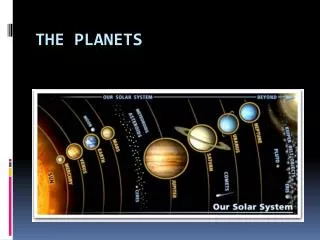
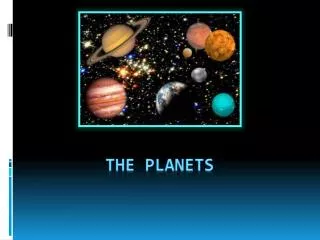
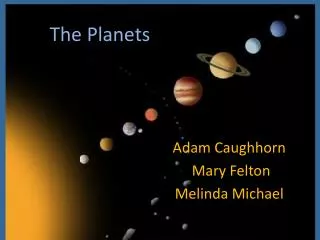
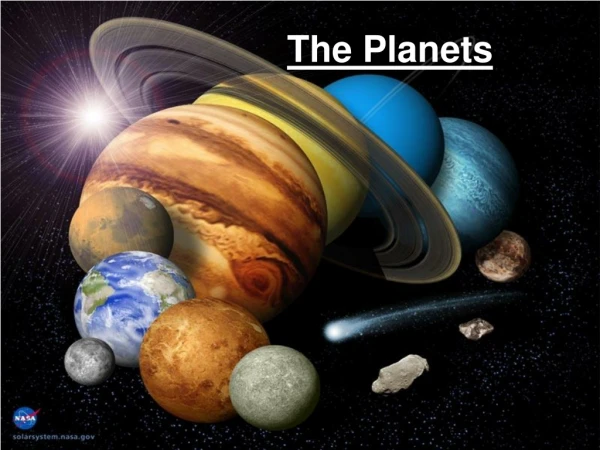
Discover the fascinating world of our Solar System, where each planet holds a mythological identity and unique characteristics. Mercury, the swift messenger god, shines brightly in our skies, while Venus is often referred to as Earth’s sister. Our home, Earth, is the only known planet with life. Mars, known as the Red Planet, is steeped in war mythology. The expanding asteroid belt lies between Mars and Jupiter, home to countless rocky bodies. The gas giants, Jupiter and Saturn, boast incredible features like massive storms and stunning ring systems, before transitioning into the icy realms of Uranus and Neptune.

Exploring the Solar System: Planets and Their Mythological Significance
E N D
Presentation Transcript
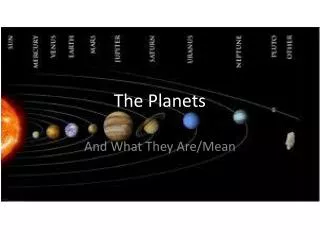
The Planets And What They Are/Mean
Mercury • Mercury is the Roman messenger God(Hermes is Greek.) • The planet probably received this name because it moves so quickly across the sky. • Mercury is seen as a star on Earth without an telescope.
Venus is the Roman God of love(Aphrodite in Greek.) • Venus reaches best brightness shortly before sunrise or shortly after sunset, for which reason it has been known as the Morning Star or the Evening Star. • Venus is sometimes called Earth’s ‘sister’
Earth • Earth is also called Terra the Roman Mother Earth(Gaia in Greek.) • Earth is Home to the only forms of living things known (as of 16 May 2012.) • Earth is tilted at 23.4° because earlier a massive asteroid hit earth.
Mars • Mars is named after the Roman God of war(Ares in Greek.) • it is often described as the "Red Planet" as the iron oxide prevalent on its surface gives it a reddish appearance. • Iron oxide is composed of iron and oxygen.
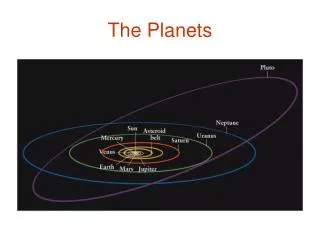
Asteroid belt • The asteroid belt is the region of the Solar System located roughly between the orbits of the planets Mars and Jupiter. • The asteroid belt is home to asteroids as small as your little finger and as big as Pluto. • The biggest is the dwarf planet Ceres.
Jupiter • Jupiter is the Roman king of Gods, God of the skies and master of lightning (Zeus in Greek.) • Jupiter is the largest planet in the Solar System (that is probably why its called Jupiter.) • The Great Red Spotis a giant storm that is known to have existed since at least the 17th century when it was first seen by telescope.
Saturn • Saturn is the Roman Titan lord of time (Kronos in Greek.) • Saturn has a ring system that has nine continuous main rings composed mostly of ice particles with a smaller amount of rocky debris and dust. • Titan, Saturn's largest and the Solar System's second largest moon, is larger than the planet Mercury
Uranus • Uranus is the Greek father sky • In mythology Uranus’s son Saturn cut up Uranus with his sickle. • It is the coldest planetary atmosphere in the Solar System, with a minimum temperature of 49 K (−224 °C).
Neptune • Neptune is the Roman God of the sea (Poseidon in Greek) • It is the coldest planetary atmosphere in the Solar System, with a minimum temperature of 49 K (−224 °C). • Astronomers sometimes categorize Uranus and Neptune as "ice giants“.
Dwarf Planets • A dwarf planet is a small planet that smaller then the moon. • There are five dwarf planets in the Solar System: Ceres, Pluto, Haumea, Makemake, and Eris.
How small is a dwarf planet? • Small. • Smaller then Saturn • Smaller then the moon • Smaller then the SUN
Venus is the god of… • Beauty and love • Blood and gory • Hate and ugliness • Hippies
What is the coldest planetary atmosphere in the Solar System • Mercury • Mt Everest • Me in ice • Neptune
Test your scores……. 0-1- need to work on your memory 2-well you will know next time 3-either you have a great memory or you’re a genius
Bibliography http://en.wikipedia.org/wiki/Mercury_(planet) http://en.wikipedia.org/wiki/Venus http://en.wikipedia.org/wiki/Earth http://en.wikipedia.org/wiki/Mars http://en.wikipedia.org/wiki/Asteroid_belt http://en.wikipedia.org/wiki/Jupiter http://en.wikipedia.org/wiki/Saturn http://en.wikipedia.org/wiki/Uranus http://en.wikipedia.org/wiki/Neptune