Download
1 / 5
50 likes | 170 Vues
This document provides an in-depth overview of the Kingdom Protista, as detailed by G. Burgess in 2007. Protists are eukaryotic organisms characterized by their diverse forms, including unicellular, colonial, and a few multicellular species such as algae. They are classified based on cellular composition into three main groups: fungal-like (e.g., slime molds), plant-like (e.g., green, brown, and red algae), and animal-like (e.g., ciliates and amoebas). The document elaborates on their locomotion mechanisms and includes information on parasitic protozoans responsible for diseases like malaria.

E N D
Kingdom Protista G.Burgess 2007.
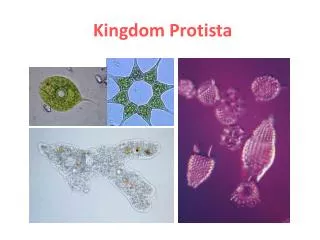
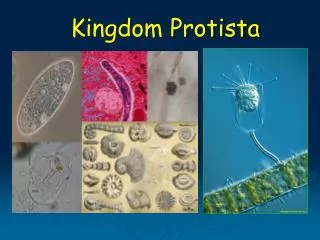
General Characteristics • Eukaryotic (membrane bound organelles) • Unicellular, colonial, few are multi-cellular (algae). • Some plant-like (have cell walls and chlorophyll) • Some fungal-like (cell wall, no chloroplasts) • Some animal-like (motile, without cell wall)
Classification • Based on physical and cellular composition • Fungal like protists • Phylum Gymnomycota (slime moulds) • fungal like (no chloroplasts, sessile, have a cell wall) • Plant like (sessile, have a cell wall, chloroplasts) protists (algae) • Phylum Chlorophyta (green algae) • Phylum Phaeophyta (brown algae) • Phylum Rhodophyta (red algae)
Classification continued • Animal like protists • Phylum Ciliophora • Use cilia for locomotion • paramecium • Phylum Sarcomastigophora • Unicellular organisms that use either a flagella or pseudopodium for locomotion • Sub-phylum Mastigophora (organisms with flagella, euglena) • Sub-phylum Sarcodina (organisms with pseudopoda, amoeba) • Phylum Apicomplexa • Parasitic protozoans: those parasites that cause malaria
Questions • Pp. 356 #1-11 Text: Biology 11, Nelson, 2002.