Download
1 / 13
130 likes | 258 Vues
The strength of acids and bases is defined by their ionization in water. Strong acids like HNO3, HCl, H2SO4, and HClO4 ionize completely, while weak acids, such as acetic acid, are less than 100% ionized. Strong bases fully ionize to produce OH- ions, creating alkaline solutions (e.g., NaOH, Ca(OH)2). In acid-base reactions, conjugate pairs are formed, where a conjugate base is left after the acid donates a proton, and a conjugate acid remains after the base accepts a proton. These reactions favor the formation of weaker acids and bases.

E N D
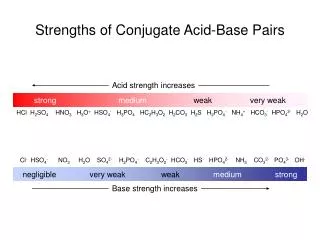
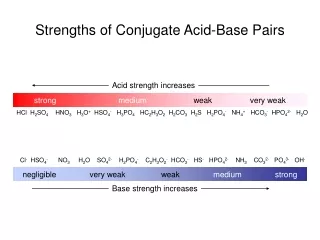
The strength of an acid (or base) is determined by the amount of IONIZATION. HNO3, HCl, H2SO4 and HClO4 are among the only known strong acids.
Strong vs. Weak Acids • Strong acid is one that ionizes completely • HNO3 (aq) ---> H+ (aq) + NO3- (aq)
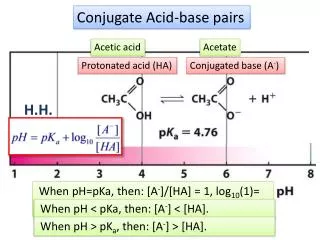
Weak Acids • Weak acids are much less than 100% ionized in water. • One of the best known is acetic acid = CH3CO2H
Base Strength • Any substance that ionizes completely to form OH- ions are strong bases • These solutions are said to be alkaline • NaOH, Ca(OH)2
Acid/Base Reactions • Whenever an acid and base react, two conjugates are produced • Conjugate base – the species that remains after the acid has given up its proton • Conjugate acid – the species that remains after the base has accepted the proton
Equilibrium • Acid/Base reactions are not just forward, the reverse reaction is also always occurring • The reaction always favors the production of the weaker acid and weaker base • The stronger the two initial reactants, the more violent the reaction
Example • For the reaction shown below, HC2H3O2 + H2O C2H3O2- + H3O+ a) Identify the acid, base, conjugate acid, and conjugate base. b) Determine which direction (forward or reverse) is favored.