Download
1 / 8
80 likes | 231 Vues
Sometimes taking actual inventory counts is impractical, especially for auditors seeking to verify balances. Estimating inventory balances can be done using two common methods: Gross Profit Method and Retail Inventory Method. The Gross Profit Method requires knowing profit markup, beginning inventory, purchases, and sales to estimate ending inventory. In contrast, the Retail Method needs information about beginning inventory and purchases at both cost and retail values. Both methods help assess inventory without physical counts, thus optimizing inventory management.

E N D
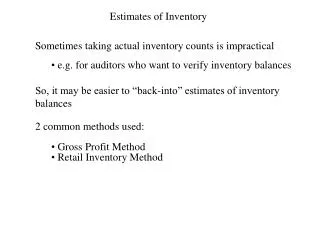
Estimates of Inventory • Sometimes taking actual inventory counts is impractical • e.g. for auditors who want to verify inventory balances • So, it may be easier to “back-into” estimates of inventory balances • 2 common methods used: • Gross Profit Method • Retail Inventory Method
Estimates of Inventory Gross Profit Method • Need the following information: • Profit markup • Beginning Inventory • Purchases • Sales
Estimates of Inventory Gross Profit Method We know Cost of Goods Available for Sale since we know Beginning Inventory and Purchases We estimate Cost of Goods Sold = Sales – Markup We then estimate Ending Inventory = CoG Available - CoGS
Then, solve for Cost Set sales to equal Cost + Markup Estimates of Inventory Gross Profit Method Beg Inv (at cost) $40,000 Purchases (at cost) $100,000 Goods Available $140,000 Sales $120,000 Markup 30% of Cost Cost of Goods Sold: Cost + 30% Cost = $120,000 1.30 Cost = $120,000 Cost = 120,000 / 1.3 = $92,308
Estimates of Inventory Gross Profit Method Beg Inv (at cost) $40,000 Purchases (at cost) $100,000 Goods Available $140,000 COGS (estimated) $92,308 End Inv (estimated) $47,692
Estimates of Inventory Retail Method • Need to know: • Beginning Inventory at cost and retail values • Purchases at cost and retail values • Sales at retail value
CostRetail Beg. Inv $50,000 $75,000 Purchases $30,000$45,000 Available for Sale $80,000 $120,000 Cost-to-retail ratio = 80,000 / 120,000 = 67% Estimates of Inventory Retail Method Goods Sold $90,000 Ending Inventory $30,000 Ending Inventory at cost = 67% x $30,000 = $20,000
CostRetail Beg. Inv $50,000 $75,000 Purchases $30,000$45,000 Available for Sale $80,000 $120,000 20% x $120,000 Cost-to-retail ratio = 80,000 / 96,000 = 83.34% Estimates of Inventory Retail Method with Markdowns Markdown $24,000 $96,000 Goods Sold $72,000 Ending Inventory $24,000 Ending Inventory at cost = 83.34% x $24,000 = $20,000 Now, assume markdown of 20% off retail price