
SlideServe
Menu
Préférences
© SlideServe · v2026

Key Components in a Balanced Program

millie avatar
28 diapositives · 455 Views · Aug 02, 2014

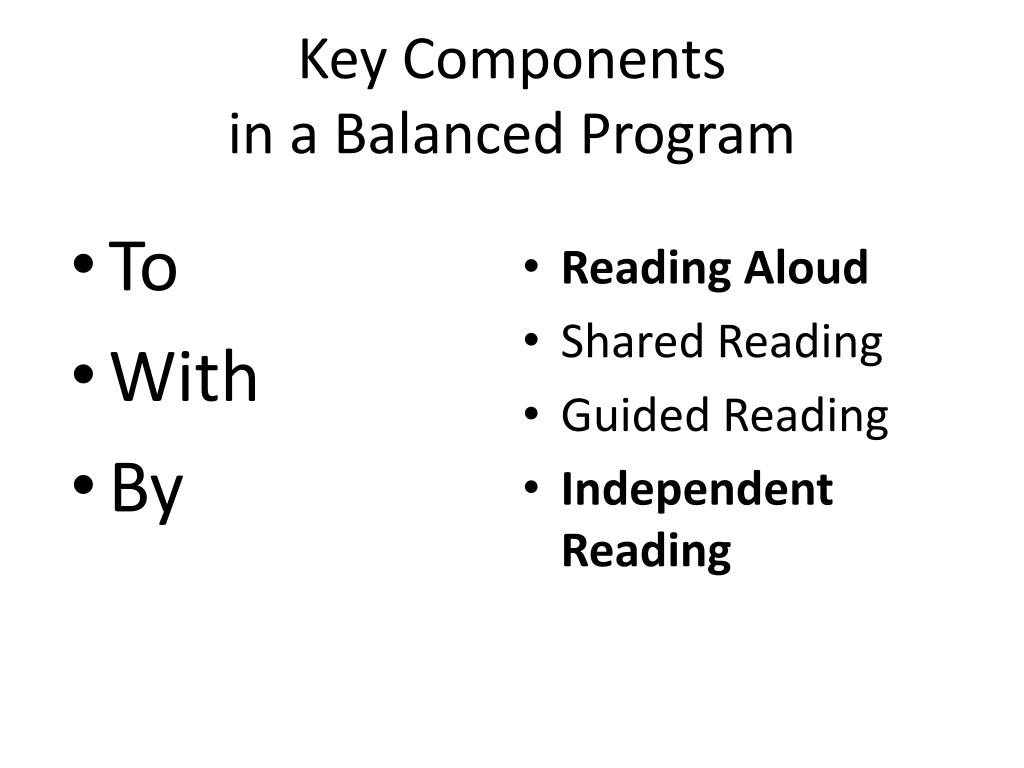
To With By. Reading Aloud Shared Reading Guided Reading Independent Reading. Key Components in a Balanced Program. Tips for Reading Aloud. Shorter pieces scattered throughout the day Intentional exposure to other genres and texts Intentional links on which to build instruction
Key Components in a Balanced Program - slide 1
01 / 28Key Components in a Balanced Program
1 / 17

Télécharger la présentation

Key Components in a Balanced Program
Une image / un lien ci-dessous est fourni (tel quel) pour télécharger la présentation

Politique de téléchargement : le contenu du site vous est fourni TEL QUEL pour votre information et votre usage personnel ; il ne peut être vendu, concédé sous licence ni partagé sur d’autres sites sans l’accord de son auteur.Le contenu vous est fourni TEL QUEL, pour votre information et votre usage personnel uniquement. Téléchargez la présentation en cliquant sur ce lien. Lors du téléchargement, si vous ne parvenez pas à télécharger une présentation, l’éditeur a peut-être supprimé le fichier de son serveur.Pendant le téléchargement, si vous ne parvenez pas à obtenir une présentation, le fichier a peut-être été supprimé par l’éditeur.

F I N

Plus de contenu associé

Transcription de la présentation
  1. To With By Reading Aloud Shared Reading Guided Reading Independent Reading Key Componentsin a Balanced Program

  2. Tips for Reading Aloud • Shorter pieces scattered throughout the day • Intentional exposure to other genres and texts • Intentional links on which to build instruction • Use to expand the vision what texts are • Use to expand the vision of who readers are

  3. Instructional Cycle Informed by Assessment Assessment Practice and Application Plan Instruction Guided Practice Model

  4. Cognitive Dimensions • Phonemic awareness • Concepts of print • Alphabetic knowledge • Word level strategies • Vocabulary • Fluency • Comprehension strategies • Overall reading level

  5. Affective Dimensions • Do your learners think they can succeed? Identity, self-efficacy, expectancy • Do your learners want to succeed? Motivation • Do our learners know what they need to do to succeed? Internal locus of control, internal reasons, self-regulatory, Pro-social behaviors

  6. One Key Fundamental… We help shape our learners’ identities as a readers and writers

  7. The Role of Identity in Reading Students construct their identities as readers at an early age. Reading identities are often constructed in terms of skills with little attention to the social and cultural factors that can influence individuals’ reading development. Students’ understandings about who they are as readers contributes to their beliefs about what they can or cannot do with texts.

  8. A Comparison of Innercity Children's Interpretations of Reading and Writing Instruction in the Early Grades in Skills-Based and Whole Language Classrooms “[A]cquiring the disposition for learning may be the most critical occurrence in the early grades…the prognosis for children who are engrossed in books at the first grade level and who think of themselves as readers and writers and are mindful of their weaknesses appears hopeful…those who in first grade have already disengaged from literacy instruction appear to have already begun the pattern of turning away from school.” Karin L. Dahl and Penny A. Freppon in Reading Research Quarterly, (Jan/Feb/Mar, 1995), pp. 50-74  

  9. Anything but Lazy: New Understandings about Struggling Readers, Teaching and Text”by Leigh Hall2006 IRA Outstanding Dissertation Conclusion: The ways in which each student transacted with the reading task demands of his/her classroom were influenced by: his or her perceptions of his or her abilities as a reader, how he or she wanted to be seen as a reader and his or her desire to comprehend and learn from text.

  10. Language Arts Receptive • Reading • Listening • Viewing Expressive • Writing • Performing • Producing All built on oral language

  11. Writing Instruction Product---------------Process

  12. Process approaches • 6 Traits plus One (Ruth Culham) • Inquiry Processes (Katie Wood Ray) • Units of Study (Lucy Calkins) • Workshop Approaches (Donald Graves)

  13. 6 Traits plus 1 • Voice • Word Choice • Ideas • Organization • Conventions • Sentence Fluency • Presentation

  14. Inquiry • Immerse • Discover • Emulate • Innovate • Personalize

  15. Units of Study • Focus • Expose • Experiment • Enhance • Integrate

  16. Workshop • Focus Lesson • Status of the Class • Draft • Revise • Edit • Polish/publish • Share

  17. To With By Reading Aloud Shared Reading Guided Reading Independent Reading Key Componentsin a Balanced Program

  18. Why whole group instruction? Why not whole group instruction?

  19. Accelerating Growth Intensive/Outside Intervention Differentiated Intervention with Individuals within the classroom Differentiated Instruction in Small Groups within the classroom Resources Whole Group Universal Instruction within the classroom Time

  20. Why whole group instruction? Why not whole group instruction?

  21. Elements Common to All Models Frontloading • Time invested on the front end of the lesson guarantees that more students will be better able to work independently away from you • Gradually turn over the responsibility for the reading and responding to the text over to the students by moving from modeling to guided practice to independent practice. • Make sure the purpose and directions for independent reading and writing are clear for all students before turning over the activity to students and starting any instruction with a small group Do-able Differentiation, p. 29

  22. Frontloading • Develop background knowledge • Activate schema • Generate interest • Address skill needs • Set a purpose