Understanding Relations Using Matrices in Rosen §7.3
Learn how matrices represent relations on finite sets, including reflexive, symmetric, and antisymmetric properties, through examples. Discover Boolean products, directed graphs, and transitivity.

Understanding Relations Using Matrices in Rosen §7.3
E N D
Presentation Transcript
Representing Relations Rosen 7.3
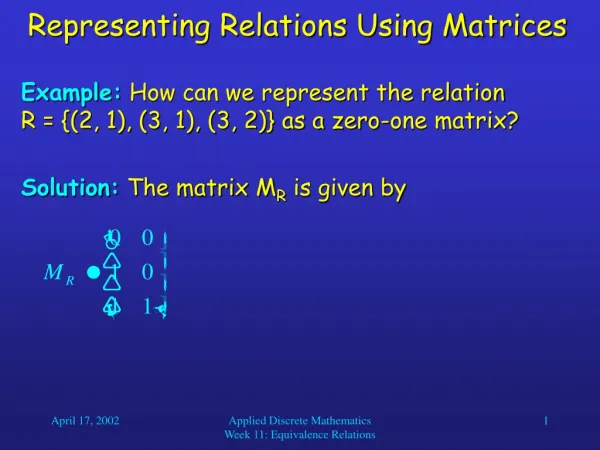
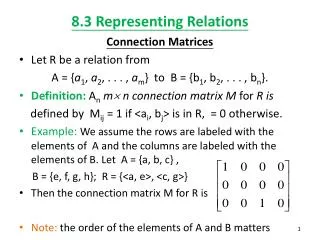
Using Matrices For finite sets we can use zero-one matrices. Elements of each set A and B must be listed in some particular (but arbitrary) order. When A=B we use the same ordering for A and B. mij = 1 if (ai,bj) R = 0 if (ai,bj) R
Example Zero-One Matrix b1 b2 b3 a1 a2 a3 R = {(a1,b1), (a1,b2), (a2,b2), (a3,b2), (a3,b3)}
Matrix of a relation on a set, A Can be used to determine whether the relations has certain properties. Recall that R on A is reflexive if (a,a) R for every element a A. Reflexive Not Reflexive
A relation R on a set A • is called Symmetric if (b,a) R whenever (a,b) R for a,b A. MR = (MR)t • is Antisymmetric if (a,b) R and (b,a) R only if a=b for a,b A is antisymmetric. • If mij = 1, ij, mji = 0 Symmetric Antisymmetric Neither
Examples Reflexive Symmetric Reflexive Antisymmetric
Let R1, R2 be relations on A A = {1,2,3} R1 = {(1,1), (1,3), (2,1), (3,3)} R2 = {(1,1), (1,2), (1,3), (2,2), (2,3), (3,1)}
R1R2, R1R2 MR1R2 = MR1 MR2, MR1R2 = MR1 MR2
What is R2 R1? R1 = {(1,1), (1,3), (2,1), (3,3)} R2 = {(1,1), (1,2), (1,3), (2,2), (2,3), (3,1)} The composite of R1 and R2 is the relation consisting of ordered pairs (a,c) where a A, c A, and for which there exists an element b A such that (a,b) R1 and (b,c) R2. R2 R1 = {(1,1), (1,2), (1,3), (2,1), (2,2), (2,3), (3,1)}
Boolean Product Let A = [aij] be an m by k zero-one matrix and B = [bij] be a k by n zero-one matrix. Then the Boolean Product of A and B denoted by A B is the m by n matrix with i,j entry cij where cij = (ai1b1j) (ai2 b2j) ... (aik bkj).
What is R2 R1? R2 R1 = {(1,1), (1,2), (1,3), (2,1), (2,2), (2,3), (3,1)} MR2R1 =MR1 MR2
Directed Graphs (Digraph) • A directed graph consists of a set V of vertices together with a set E of ordered pairs of elements of V called edges. • (a,b), a is initial vertex, b is the terminal vertex Reflexive (Loops at all vertices) Symmetric (All edges both ways) b a c
Relation R on a set A R = {(a,b), (b,b), (b,c), (c,a), (c,c)} Transitive? No b a c R = {(a,b), (b,b), (b,c), (a,c), (c,c)} Transitive? Yes b a Rosen, pp. 493-494 c
Relation R on a set A R = {(a,a), (a,c), (b,b), (b,a), (b,c), (c,c)} Reflexive Antisymmetric Transitive b a c