Understanding Measures of Central Tendency: Mean, Median, and Mode Explained
70 likes | 187 Vues
This guide explores the three primary measures of central tendency: mean, median, and mode. The mean is the arithmetic average of a dataset, while the median represents the middle value when data is sorted. The mode identifies the most frequently occurring value. Learn how to calculate and interpret these statistics using example data, including scenarios for unimodal, bimodal, and multimodal distributions. We provide exercises to reinforce your understanding of these key concepts and their application in statistical analysis.


Understanding Measures of Central Tendency: Mean, Median, and Mode Explained
E N D
Presentation Transcript
Measures of Central Tendency Numbers describing typical data values
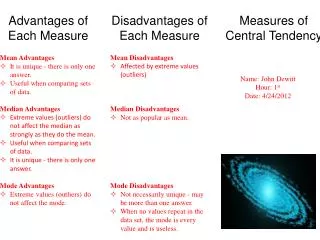
The Big Three – Mean, Median & Mode • Mean • Most common measure • Arithmetic average • Statistical symbols
Arithmetic Mean • Population mean • Sample mean
Feb 10 Mar 9.5 Apr 7.3 May 4.8 Jun 3 Arithmetic Mean
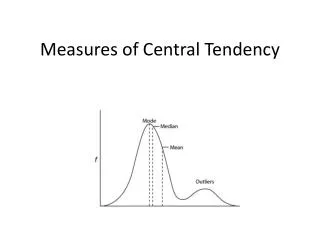
Median • Median • The middle value, when listed from smallest to largest. • Half of data is above median, half below • With even number of data values, median is half-way between the two central values • 3 5 7 7 9 10 11 33 50 Median = 9 • 3 5 7 9 10 11 33 50 Median = 9.5
Mode • Mode • Value that occurs with greatest frequency • Unimodal • 3 5 8 1 -7 2 5 • Bimodal • 3 5 -7 1 -7 2 5 • Multi-modal • 3 5 -7 1 -7 3 5 • No mode • 3 5 8 1 -7 2 5 • Or • 3 5 -7 -7 3 5
Practice Exercise Consider the following data: 4, -8, 4, -12, 8, 4, -14 What is the value of the mean? What is the value of the median? What (if any) is the value of the mode(s)? What is the range?