
The Great Depression
E N D
Presentation Transcript
The Great Depression Prosperity Shattered Hard Times Hoover’s Policies
Activity • What is most money spent on during the 1920s? • What is the economic boom based on in the 1920s? • How did one man’s actions affect the condition of banks in 1928? • What affect does the stock market crash have on employment? • How does the Dust Bowl affect the health of men, women and children living on the plains? • What was the original purpose of developing Mount Rushmore? • What is Germany doing in Europe while America is going through the Great Depression? • How does boxer Joe Louis’ rematch against Germany reflect America’s attitude during the Great Depression?
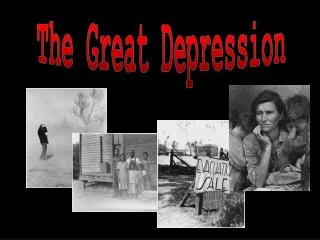
Bell Ringer • Look at pages 358 and 398 to answer the following questions: • What is going on in this picture? Why? • Does the picture display the state of the economy? How do you know? • What is different about these two pictures?
Objectives • Describe why the stock market crashed in 1929. • Analyze the main causes of the Great Depression.
Timeline Activity 11 • Read over the paragraphs at the top of the sheet and follow the directions below.
Economic Troubles on the Horizon • Era of prosperity becomes era of economic problems • People use credit to help promote business • Clash between a bull market and a bear market
The Stock Market Crashes • Bubble bursts on Black Thursday • Prices sink to shocking low on Black Tuesday
The Depression Begins • People have trouble paying loans • Businesses are failing • Marking the beginning of the Great Depression
Causes of the Great Depression • Economic trouble in Europe • Smoot-Hawley Tariff has opposite affect on economy • What do historians think???
The Great Depression Prosperity Shattered Hard Times Hoover’s Policies
Activity • Responses to the Depression Activity Sheet • Individual (30 seconds each) • Group (1 minute each) • Final Results • #1)Most Reasonable: • #1)Least Reasonable: • #2)Most Reasonable: • #2)Least Reasonable: • #3)Most Reasonable: • #3)Least Reasonable:
Bell Ringer • Read over The Depression Takes Its Toll and answer the questions on the back.
Objectives • Describe how unemployment during the Great Depression affected the lives of American workers. • Compare and contrast the hardships that urban and rural residents faced during the depression. • Analyze how the Great Depression affected family life and the attitudes of Americans. • Explain how popular culture provided an escape from the Great Depression.
American Workers • By 1933 15 million are unemployed • Immigration decreases • Economic troubles add to discrimination • Women working increases • Most sell apples as a form of income
Life in the City • Salvation Army and Red Cross provide relief • Mutualistas formed to look out for others • Breadlines allowed for a source of food • Malnutrition and homelessness are major problems
Math in Social Studies • During the Great Depression (1929-1941), for every 8 hours of the day 1 person would die due to malnutrition. How many people died during the Great Depression from malnutrition?
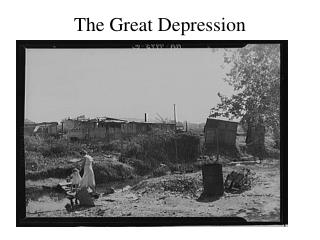
“HOOVERVILLE” • Shantytowns were created to act as shelters
Life on the Farms • Supply exceeds demand • Banks begin to foreclose on farms
The Great Depression in the City and the Country • Received aid from charities • Experienced hunger and homelessness • Mutual-aid organizations • Faced lower prices for food products • Forced to let crops rot • Faced farm foreclosures • Experienced poverty • Experienced diminished expectations URBAN RURAL
Family Life • Marriage rates and birthrates decline • Women have to provide for family in multiple ways • Depressions describe the economy and the mood
The Great Depression Prosperity Shattered Hard Times Hoover’s Policies
Bell Ringer • Read the letter from Father Flye as he addresses the biggest concern of the Great Depression. • Answer the questions on the back.
Objectives • Explain why Hoover opposed government relief programs. • Outline the Hoover administration’s attempts to solve the economic problems of the depression. • Analyze why Franklin D. Roosevelt was such a popular candidate in the 1932 election.
Hoover’s Philosophy • Believes in rugged individualism • Build character, volunteer • Assist in relief efforts • Community Chest • Red Cross • YMCA • Salvation Army
Boost the Economy • Public works projects (Hoover Dam) • Federal Farm Board allows government to hand out loans • Hope for a trickle effect
Rumblings of Discontent • Groups become more vocal • Socialists, Communists encourage activism • Bonus Army and the shocking treatment to veterans
The Election of 1932 • Democrats choose Franklin D. Roosevelt • He promises a “new deal” in life